Are Automatic Knives Legal in Texas?
The Short Answer
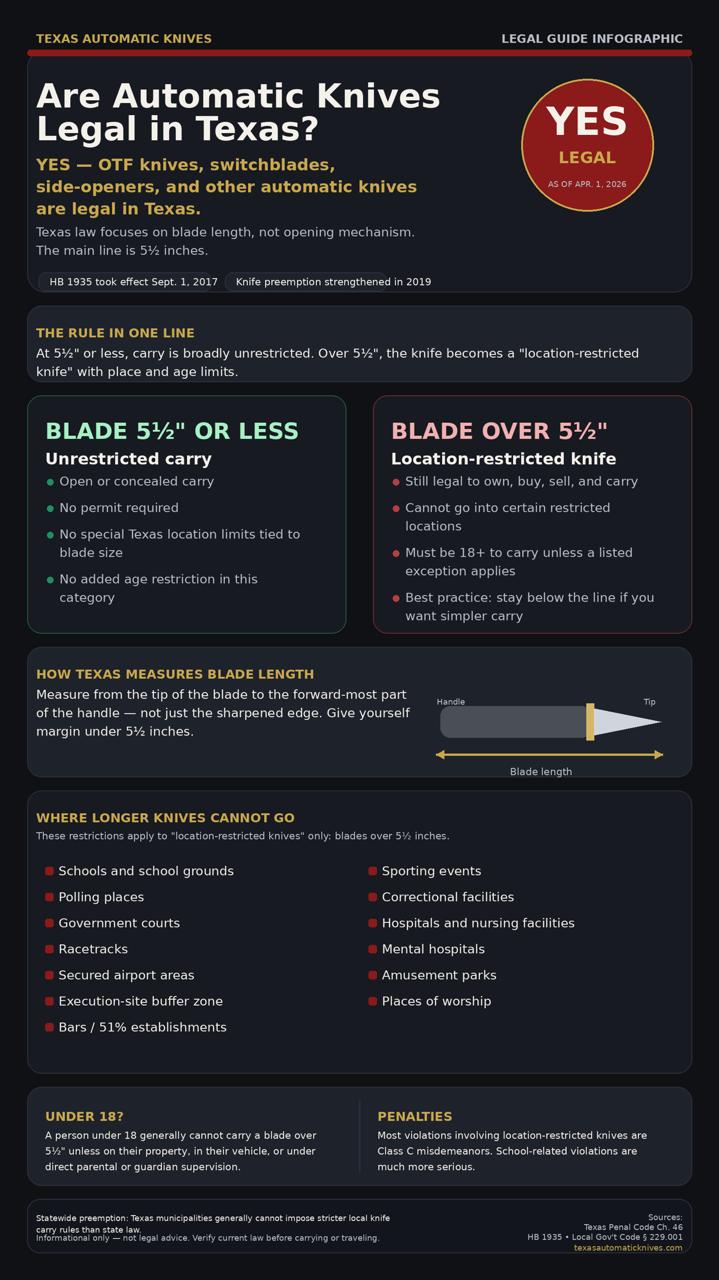
Yes. Automatic knives — OTF knives, switchblades, side-opening autos, all of them — are completely legal to own, buy, sell, and carry in Texas. Open carry, concealed carry, no permit required. This has been the case since September 1, 2017, when House Bill 1935 took effect and rewrote the state's knife laws from the ground up.
But Texas isn't a free-for-all. The law draws one clear line: blade length. Any knife with a blade over 5½ inches is classified as a "location restricted knife," and there's a specific list of places you can't take it. Under that threshold, you can carry it anywhere with virtually no restrictions.
This is our home state. We know these laws inside and out. Here's the full picture.
The History: How Texas Knife Law Changed
For decades, Texas had some of the most confusing knife laws in the country. The old Penal Code § 46.01 defined "illegal knife" as a category that included daggers, dirks, stilettos, bowies, swords, spears, and — critically — any knife with a blade over 5½ inches. Switchblades weren't specifically listed as "illegal knives," but the overall framework was murky, enforcement was inconsistent, and plenty of law-abiding Texans got tripped up.
House Bill 1935, authored by Representative John Frullo and signed by Governor Greg Abbott, changed everything. Effective September 1, 2017, HB 1935:
- Eliminated the "illegal knife" category entirely. No knife is illegal to own in Texas based on its type, design, or opening mechanism.
- Removed switchblades, daggers, dirks, stilettos, and bowies from the prohibited list. These terms no longer appear in the Penal Code as banned items.
- Created the "location restricted knife" concept — a simpler, objective standard based solely on blade length.
- Set the threshold at 5½ inches. Over that length = location restricted. At or under = unrestricted.
The result is one of the cleanest, most collector-friendly knife laws in the country.
What Texas Law Actually Says
The Statutes (Texas Penal Code Chapter 46)
The key definitions are in § 46.01:
"'Location-restricted knife' means a knife with a blade over five and one-half inches."
"'Knife' means any bladed hand instrument that is capable of inflicting serious bodily injury or death by cutting or stabbing a person with the instrument."
That's it. No mention of opening mechanism. No mention of blade style. No mention of single-edge versus double-edge, fixed versus folding, manual versus automatic. Texas law cares about exactly one thing: how long is the blade?
How Blade Length Is Measured
Texas appellate courts have established that blade length means the flat-edged part of the knife from the tip to the handle — not just the sharpened portion. In McMurrough v. The State of Texas, 995 S.W.2d 944 (1999), the Court of Appeals upheld a conviction where the blade measured 6 inches from tip to handle, even though the defendant argued only the sharpened portion (about 5½ inches) should count.
This measurement standard is consistent with the AKTI Protocol for Measuring Knife Blade Length: a straight line from the tip of the blade to the forward-most aspect of the handle.
Practical advice: Don't push it to the edge. If you want unrestricted carry, give yourself some margin below 5½ inches.
What That Means in Plain English
- Blade 5½ inches or less: Carry it anywhere. Open or concealed. No permit. No age restriction. No restricted locations. This covers the vast majority of automatic knives, OTF knives, and EDC folders.
- Blade over 5½ inches: Legal to own and carry, but you can't take it to certain locations (listed below). Must be 18 or older to carry. Open and concealed carry are both fine everywhere else.
OTF Knives in Texas
OTF knives are 100% legal in Texas. The law doesn't distinguish between OTF, side-opening automatic, assisted, or manual knives. If the blade is 5½ inches or under, carry it anywhere. If it's over 5½ inches, it's a location restricted knife — still legal to carry, just not in the places listed below.
Switchblades vs. Automatic Knives: What Texas Considers Them
Texas law doesn't use the terms "switchblade" or "automatic knife" at all. Those terms were removed when HB 1935 eliminated the "illegal knife" category. The old distinctions between switchblades, gravity knives, daggers, and bowies are gone. Texas cares about blade length, period.
Whether your knife is a Microtech Ultratech, a Benchmade Infidel, a Buck 110, or a Bowie knife your grandfather left you — the same rules apply. Blade over 5½ inches? Location restricted. Under? Unrestricted.
Carrying an Automatic Knife in Texas
Open Carry
Legal for all knives. No restrictions on open carry regardless of blade length — though a location restricted knife (over 5½") still can't be taken into the restricted locations listed below.
Concealed Carry
Legal for all knives. Texas does not require a permit, license, or any form of authorization to carry a knife concealed. This applies to automatics, OTFs, fixed blades, folders — everything.
Where You Can't Carry a Location Restricted Knife
Here's where the 5½-inch line matters most. § 46.03 lists the places where a "location restricted knife" (blade over 5½") is prohibited. If your auto knife has a blade under 5½ inches, none of these restrictions apply to you.
Category 1: Places Where Firearms AND Location Restricted Knives Are Prohibited (§ 46.03(a))
1. Schools and educational institutions — any public or private school premises, grounds, buildings, or school transportation vehicles. (Exception: with written authorization from the institution.) 2. Polling places — on election day or during early voting. 3. Government courts — any court premises or offices utilized by the court. (Exception: with written authorization from the court.) 4. Racetracks 5. Secured areas of airports 6. Within 1,000 feet of an execution site — on days a death sentence is scheduled, if you received notice of the prohibition.
Category 2: Places Where Location Restricted Knives Are Specifically Prohibited (§ 46.03(a-1))
1. Bars and 51% establishments — any business licensed under the Alcoholic Beverage Code that derives 51% or more of its income from on-premises alcohol sales. 2. Sporting events — high school, collegiate, or professional sporting events and interscholastic events. (Exception: participants who use a location restricted knife in the event.) 3. Correctional facilities 4. Hospitals — licensed hospitals and nursing facilities. (Exception: with written authorization from administration.) 5. Mental hospitals — (Exception: with written authorization from administration.) 6. Amusement parks 7. Places of worship — churches, synagogues, and other established places of religious worship.
Penalties
- Most location restricted knife violations under § 46.03 are a Class C misdemeanor — a fine up to $500, no jail time.
- The exception: bringing a location restricted knife onto school premises is a third-degree felony — 2 to 10 years in prison and a fine up to $10,000.
That school exception is no joke. Don't bring a knife with a blade over 5½ inches anywhere near a school.
Age Restrictions
Under 18: Cannot carry a location restricted knife (blade over 5½") except:
- On their own property or property they control
- Inside or directly en route to their own motor vehicle or watercraft
- Under the direct supervision of a parent or legal guardian
Per § 46.02(a-4), it's an offense for a person under 18 to intentionally, knowingly, or recklessly carry a location restricted knife outside these exceptions.
§ 46.06(a-2) makes it unlawful to sell, provide, or offer to sell a location restricted knife to someone under 18. An affirmative defense exists if the parent or guardian gave written permission.
Under 18 with a blade 5½ inches or less: No restrictions whatsoever. A 16-year-old can legally carry a 5-inch OTF knife in Texas without limitation.
There's also an exception in § 46.15 for hunting, fishing, or sporting activities — minors engaged in lawful outdoor pursuits can carry location restricted knives en route between the activity and their home or vehicle.
Statewide Preemption
Texas has strong statewide preemption for knife laws. Texas Local Government Code § 229.001(a)(1) provides that municipalities may not adopt regulations relating to the transfer, possession, wearing, carrying, or transportation of knives. This includes:
- Public parks
- Parades
- Public meetings
- Political rallies
No city in Texas — not Houston, not Dallas, not San Antonio, not Austin — can create knife laws stricter than state law. What's legal under Chapter 46 is legal everywhere in the state.
Municipalities may regulate knife use during insurrections, riots, or natural disasters if they determine the regulation is necessary for public health and safety. But short of civil unrest, you're covered statewide.
What About Assisted Openers?
Assisted-opening knives are legal in Texas. But so are fully automatic knives. The distinction between assisted openers and automatic knives doesn't have any legal significance in Texas — neither category is restricted. It's all about blade length.
Buying Automatic Knives in Texas
No state restrictions on purchasing automatic knives. You can buy them in person, online, at knife shows, wherever. The only sales restriction: don't sell a location restricted knife (blade over 5½") to someone under 18 unless you have written parental permission.
For online purchases, the Federal Switchblade Act prohibits interstate shipment of automatic knives to individuals via common carriers — but this is widely understood to apply to sales by manufacturers/dealers to non-dealers, and many sellers ship to Texas without issue. If you're buying from a dealer who ships to your state, you're generally in the clear.
Law Enforcement and Military Exceptions
§ 46.15 provides extensive exemptions from both § 46.02 and § 46.03 for:
- Peace officers and special investigators (on or off duty)
- Parole officers (on duty, per department policy)
- Active judicial officers with handgun licenses
- Honorably retired peace officers with proficiency certificates
- Active military and state military forces
- Licensed security officers
- And several other categories of government employees and first responders
These exemptions mean law enforcement and military personnel can carry any knife, including location restricted knives, in locations where civilians cannot.
Recent Law Changes
- September 1, 2017: HB 1935 takes effect. Eliminates the "illegal knife" category. Legalizes switchblades, daggers, bowies, and all knife types. Creates the "location restricted knife" classification (blade over 5½"). Adds restricted locations under § 46.03(a-1).
- September 1, 2019: Statewide preemption for knives strengthened under LGC § 229.001.
Frequently Asked Questions
Can I carry an OTF knife in Texas?
Yes. OTF knives are legal to own and carry — open or concealed, no permit required. If the blade is 5½ inches or less, carry it anywhere. If it's over 5½ inches, avoid the restricted locations listed above.
Are switchblades illegal in Texas?
No. Texas eliminated its switchblade ban in 2017 with HB 1935. All automatic knives are legal.
Is there a blade length limit for automatic knives in Texas?
Not for ownership or general carry. The 5½-inch threshold only determines whether your knife is "location restricted" — meaning you can't bring it to schools, bars, courthouses, hospitals, sporting events, amusement parks, or places of worship. Under 5½ inches, there are zero location restrictions.
Can a minor carry an automatic knife in Texas?
If the blade is 5½ inches or less, yes — no age restrictions apply. If the blade is over 5½ inches, a person under 18 can only carry it on their own property, in their vehicle, or under direct parental supervision.
What happens if I carry a location restricted knife into a prohibited location?
For most locations, it's a Class C misdemeanor (fine up to $500). For schools, it's a third-degree felony (2-10 years imprisonment). Don't test the school restriction.
Legal Disclaimer
This article is for informational purposes only and does not constitute legal advice. Knife laws change — sometimes faster than websites update. Federal, state, and local laws may all apply to your situation, and local ordinances can be more restrictive than state law.
Before purchasing, carrying, or traveling with any automatic knife, OTF knife, or switchblade, verify current laws with official state and local sources. We are not attorneys, and we are not responsible for actions taken based on this information.
When in doubt, consult a licensed attorney in your jurisdiction.