Celtic Guardian Rapid-Assist Pocket Knife - Onyx Black
13 sold in last 24 hours
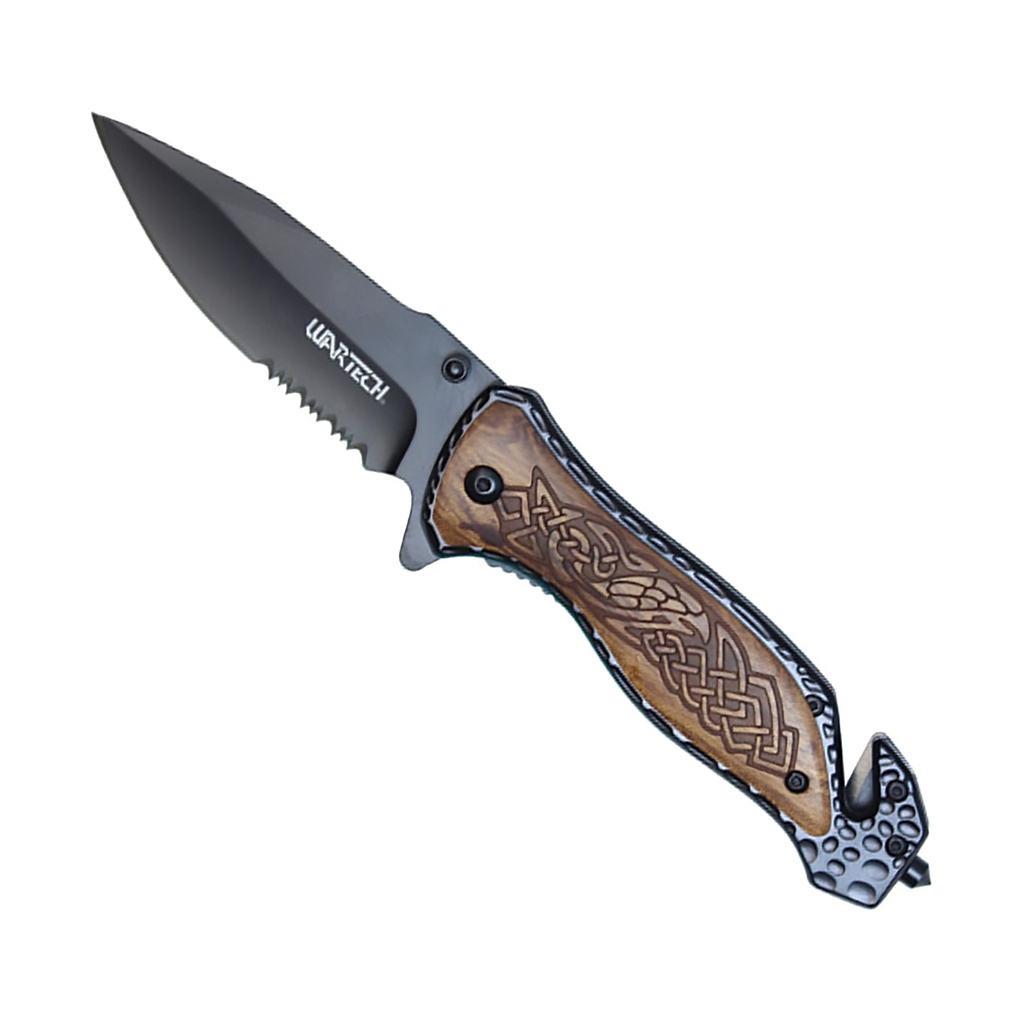
This spring-assisted pocket knife brings Celtic soul to a modern Texas EDC. A matte black, partially serrated clip point snaps open with a thumb stud and assist, then locks with a solid liner lock. The Celtic knot wood inlay set into the black metal handle adds heritage, while the seatbelt cutter, glass breaker, and deep-carry clip keep it rescue-ready. At 4.5 inches closed, it rides light, opens fast, and feels like a story you chose on purpose.
| Blade Length (inches) | 3.5 |
| Overall Length (inches) | 8 |
| Closed Length (inches) | 4.5 |
| Weight (oz.) | 4.2 |
| Blade Color | Black |
| Blade Finish | Matte |
| Blade Style | Clip Point |
| Blade Edge | Serrated |
| Blade Material | Stainless Steel |
| Handle Finish | Matte |
| Handle Material | Metal |
| Theme | Celtic |
| Pocket Clip | Yes |
| Deployment Method | Spring-assisted |
| Lock Type | Liner lock |
Celtic Guardian Rapid-Assist Pocket Knife - Onyx Black
This knife is a spring-assisted pocket knife first, a Celtic statement piece second. You’ve got a folding EDC with a thumb stud and assist spring doing the work — not an automatic knife, not an OTF knife, and not a switchblade pretending to be something it isn’t. One clean press on the stud, the spring takes over, and that matte black clip point snaps into place with a liner lock you can trust.
What This Assisted Pocket Knife Really Is
Mechanically, this is a side-opening, spring-assisted folding knife. You start the motion with your thumb; the assist spring finishes it. That’s a different world from a true automatic knife or switchblade, where a button or hidden release fires the blade without you starting the swing, and a long way from an OTF knife that tracks in and out through the handle. Texas collectors know those differences aren’t trivia — they decide how you carry, how you maintain, and how the knife feels in hand.
Here, the assisted opening makes it quicker than a plain manual folder, but with the same familiar pivot and liner lock setup you’ve handled a thousand times. It’s an EDC tool tuned for real use: one-handed deployment, one-handed close, and no mystery about how the mechanism works.
Mechanism & Build: Spring-Assisted Confidence
Deployment You Can Feel, Not Guess
The matte black, partially serrated clip point blade rides on a thumb stud and assist spring. Ease the stud forward, the spring kicks in, and the blade snaps open with enough authority to let you know it’s locked. Unlike an OTF knife, there’s no track to clean, and unlike a push-button automatic knife, there’s no separate firing mechanism to baby. Just a straightforward assisted system that rewards a little oil and the occasional wipe-down.
The liner lock engages cleanly along the tang, visible through the black metal frame. It’s simple, familiar, and easy to inspect — exactly what you want in a working Texas pocket knife that might see rope, cord, or the occasional fence repair.
Blade & Handle Made for Use
The stainless steel blade wears a matte black finish and a partially serrated edge. The clip point gives you a sharp tip for precision cuts, while the serrations chew through strap, cardboard, or nylon webbing without a fuss. Stainless steel won’t impress a steel snob on paper, but in Texas heat, sweat, and glovebox life, it earns its keep with basic maintenance and honest use.
The handle is black-coated metal with a wood inlay carved in Celtic knotwork. That inlay isn’t just pretty — it adds a warm, tactile center panel against the harder metal frame. Jimping along the spine near the handle gives your thumb a natural anchor, and the rear of the handle houses a seatbelt cutter and glass breaker, turning this from "nice knife" into practical rescue tool.
Texas Carry Reality: Assisted Knife Built for the Lone Star Day
In Texas, this spring-assisted pocket knife rides where real life happens: clipped in a pair of jeans on the way to the lease, tucked inside a work shirt at the jobsite, or parked in the console for long stretches of I‑35. It’s not an OTF knife rocketing out the front, and it’s not a button-activated switchblade; it’s a thumb-stud assisted opener that stays ready without drawing the wrong kind of attention.
The deep-carry pocket clip lets it sit low in the pocket, black-on-black against denim or khaki. At 4.5 inches closed and about 4.2 ounces, it disappears until you need it, then opens fast enough to cut a hay strap, break a window in a highway accident, or slice down a box on the porch. The rescue hook at the butt is built for webbing and seatbelts, while the glass breaker gives you a purpose-built way out when things go sideways.
Heritage Meets Function: The Celtic Story in a Texas Pocket
That Celtic knot panel is the first thing folks will notice. It’s not loud, but it’s deliberate — interlaced lines cut into warm wood, framed by black metal. For a Texas knife collector, it hits a familiar chord: a touch of old-world pattern welded into a modern assisted opening knife. This isn’t some novelty switchblade covered in decals; it’s a working EDC with a design nod to the kind of stories that outlast their owners.
Collectors who already own an OTF knife or a full-on automatic knife will recognize this one’s lane. It doesn’t try to out-fire a switchblade. Instead, it offers an assisted folder you can hand to someone without a tutorial, with a look that stands out in a drawer full of G‑10 and black-on-black tacticals.
What Texas Buyers Ask About Assisted Pocket Knives
Is an assisted pocket knife the same as a switchblade or OTF?
No, and that difference matters. An assisted pocket knife like this Celtic Guardian needs you to start the blade moving with the thumb stud; then the internal spring helps finish the opening. A traditional switchblade or automatic knife uses a button or release to fire the blade from a closed position without you starting the motion. An OTF knife — out-the-front — drives the blade straight out of the handle along a track, usually with a slider. Same broad family of modern folders, three very different mechanisms. This one stays firmly in the assisted opening lane.
How does Texas law treat an assisted opening knife like this?
Texas law has relaxed a lot over the years, especially for adults carrying knives, but the important part is understanding what you’re actually carrying. This spring-assisted pocket knife opens with a thumb stud and assist spring, not a push-button switchblade mechanism and not an OTF track system. That puts it with the familiar side-opening folders most Texans have carried for decades. Still, laws change and local rules can vary, so a serious Texas buyer checks the current state statutes and any local ordinances before making this their daily ride.
Why would a collector add this if they already own automatics and OTFs?
Because a good collection isn’t just louder, faster, meaner — it’s broader and smarter. If you already own a couple of automatic knives and at least one OTF knife, this assisted pocket knife fills a different niche. It’s a rescue-ready EDC with seatbelt cutter and glass breaker, a serrated clip point that begs for work, and that Celtic knot handle that marks it at a glance. It’s the piece you clip on when you want heritage in your pocket and a mechanism any friend can run without a lecture. That mix of usability and design makes it more than filler in a Texas drawer.
Texas Collector Identity: A Knife That Knows Its Place
A serious Texas knife buyer doesn’t confuse buzzwords. They know what separates an automatic knife from an assisted opener, and how an OTF knife lives in its own category. This Celtic Guardian Rapid-Assist Pocket Knife - Onyx Black respects that. It stays honest about what it is: a spring-assisted, side-opening EDC with real rescue features and a Celtic soul. If you’re building a collection that says you understand those differences — and you like a little story carved into your steel — this one earns its spot in the roll without needing to shout about it.