Crowned Trail Heritage Boot Knife - Damascus Stag
3 sold in last 24 hours
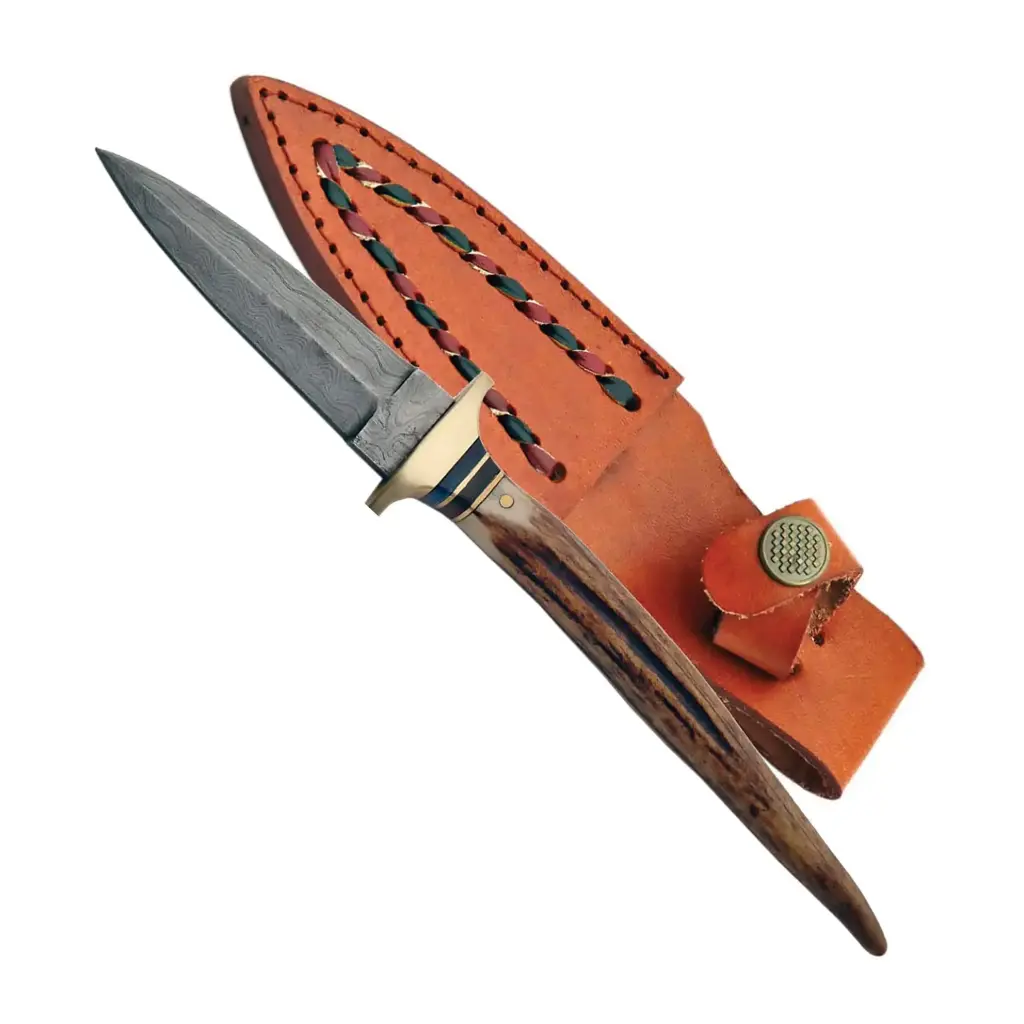
This boot knife is a compact fixed blade built the old Texas way: honest materials, no drama. A patterned Damascus dagger blade rides ahead of a full-tang stag antler crown, giving you real texture and control in a tight 8-inch package. The fitted leather sheath disappears in a boot or along the belt. For Texas buyers who know the difference between a boot knife and a folder, this is quiet heritage you can actually put to work.
| Overall Length (inches) | 8 |
| Blade Color | Silver |
| Blade Finish | Patterned |
| Blade Style | Dagger |
| Blade Edge | Plain |
| Blade Material | Damascus |
| Handle Material | Stag |
| Theme | Damascus |
| Carry Method | Sheath |
| Sheath/Holster | Leather |
What a Damascus Boot Knife Really Is
This is a true Damascus boot knife: a compact fixed blade dagger meant to ride low and stay ready. No button, no spring, no sliding track. Just patterned steel, a solid tang, and a stag antler crown you can lock into. In a world where everything with a point gets called a switchblade, this one stands on the older side of the family tree—plainspoken steel you draw by hand, not an automatic knife you fire with a mechanism.
At 8 inches overall with a 3.5-inch double-edged dagger blade, this boot knife slips into tight spaces without giving up control. The Damascus pattern isn’t just for looks; it signals layered steel and old-world craft, the kind Texas collectors recognize at a glance. The stag handle and leather sheath keep it firmly in the heritage camp, not the tactical cosplay aisle.
Damascus Boot Knife vs. Automatic Knife and Switchblade
Mechanically, this Damascus boot knife couldn’t be clearer: it’s a fixed blade. The steel runs full tang into that stag crown, and the only moving part is your hand. That’s a different animal than an automatic knife, where a spring drives the blade open from a folded position at the push of a button. It’s also a far cry from any OTF knife—those out-the-front switchblades that shoot the blade along a track through the handle.
A Texas buyer who knows their mechanisms will read this piece instantly: double-edged dagger profile, no pivot, no button, full tang visible at the guard. That’s a boot knife, not a side-opening automatic, not a modern OTF. The distinction matters when you’re talking Texas law, maintenance, and how you actually carry the thing day to day.
Why Fixed Blade Still Matters to Texas Collectors
For all the talk about OTF knives and push-button switchblades, fixed blades like this still anchor a serious Texas collection. They don’t depend on a spring, a button, or a proprietary track system. You can sharpen them on a stone in hunting camp and trust that stag handle to behave wet, dry, hot, or cold. When a piece is going into a boot, that kind of certainty ranks higher than any deployment trick.
Texas Carry Reality for a Damascus Boot Knife
Texas law has loosened up over the years, and that’s been good news for folks who like steel. Today, a fixed blade boot knife like this Damascus dagger can be carried openly or concealed in most everyday situations, so long as you’re not stepping into restricted locations like schools, certain government buildings, or other posted premises. The key point: this is not an automatic knife, not an OTF knife, and not a switchblade in the mechanical sense—there’s no mechanical opening at all, just a draw from leather.
The fitted leather sheath with snap strap is built for discreet carry. It disappears in a boot leg, tucks along a belt, or rides behind a truck seat without calling attention to itself. That’s a different carry story than an OTF knife clipped in a front pocket or a side-opening automatic knife riding in a business slacks waistband. Texas buyers who rotate between all three types appreciate having a fixed blade that stays quiet and traditional.
Boot Sheath: How It Actually Rides
The leather sheath on this boot knife uses a snap strap to capture the stag crown and pommel, keeping the Damascus blade locked until you mean to draw it. The colored lacing and stitching aren’t there to shout; they’re there to hold. Slide it inside a boot and you get that old ranch-hand feeling—steel on one side, leather on the other, nothing to fail between them.
Mechanics and Materials: Damascus and Stag Done Right
The heart of this knife is the patterned Damascus blade—a double-edged dagger with a clean, plain edge on both sides. Collectors recognize that wave pattern as more than decoration. It’s layered steel, heat-treated and ground down to a fine point that slides in and out of leather and fabric without much persuasion.
The handle is stag antler, left crowned at the pommel so you keep the natural shape and texture. That crown, backed by a brass guard and spacers, gives your palm a positive index without needing rubber inserts or aggressive texturing. In wet or cold conditions, that kind of organic grip can be easier to trust than some modern synthetics. The full tang runs all the way through, so what you’re feeling is steel backed by antler, not antler glued to a stub.
How It Compares to Modern OTF and Switchblade Builds
Modern OTF knives and switchblades lean on aluminum frames, internal springs, and track tolerances that have to stay clean to work right. This boot knife leans on something else entirely: solid tang strength, simple geometry, and reliable edge. There’s no button to wear, no automatic mechanism to gum up, just a Damascus blade that will outlast most pockets it rides past.
Collector Value for Texas Knife Buyers
For a Texas collector with a drawer full of OTF knives, automatic knives, and classic switchblades, this Damascus boot knife fills a different slot. It’s a heritage fixed blade with real field manners—stag antler, brass, leather, and patterned steel. That combination shows well in a case, but it doesn’t have to stay there. You can actually carry it into the lease, into the truck, or into town.
Because it’s a boot knife and not a folder, the profile stays consistent year after year. Trends come and go in automatic knife styling—milled pockets, wild anodizing, oversized buttons. Damascus and stag don’t chase those waves. They sit in the collection like an anchor piece, the kind a Texas buyer points to when someone asks what they actually trust.
What Texas Buyers Ask About Damascus Boot Knives
Is a Damascus boot knife the same as an automatic, OTF, or switchblade?
No. A Damascus boot knife like this is a fixed blade dagger. You draw it from the sheath; there’s no spring, no button, no sliding track. An automatic knife is a folding design that opens with a spring when you hit a release. A switchblade is a type of automatic, either side-opening or out-the-front (OTF), where the blade is propelled by a mechanism. This boot knife gives you Damascus steel and stag, but keeps the operation as straightforward as it’s ever been.
Is it legal to carry this boot knife in Texas?
Under current Texas law, adults can generally carry a fixed blade boot knife like this Damascus dagger, open or concealed, with some location-based exceptions such as schools, certain government buildings, and other weapons-restricted premises. It’s always on you to check local ordinances and any posted signs, but mechanically this is not an automatic knife, not an OTF, and not a spring-driven switchblade—just a traditional fixed blade riding in leather.
Why would a collector pick this over another small fixed blade?
A Texas collector chooses this piece because it balances three things that rarely line up at once: real Damascus steel, genuine stag antler crown, and true boot-ready size. Plenty of small fixed blades exist, but few bring that classic Western profile—brass guard, patterned steel, leather sheath—together in a compact dagger format. It complements a lineup of OTF knives and automatics by covering the traditional boot-knife niche with materials that age well and tell a story.
In the end, this Damascus boot knife feels like something a Texas hand would have worn long before anyone argued about OTF versus side-opening automatic. It’s the quiet piece that rides in leather, waits its turn, and does the job when called. For a buyer who knows their mechanisms and values the difference between a fixed blade, an automatic knife, and a switchblade, it’s a simple choice: crown of stag, heart of Damascus, and a place in both the boot and the collection.