Damascus Current Slide-Action OTF Knife - Matte Black
12 sold in last 24 hours
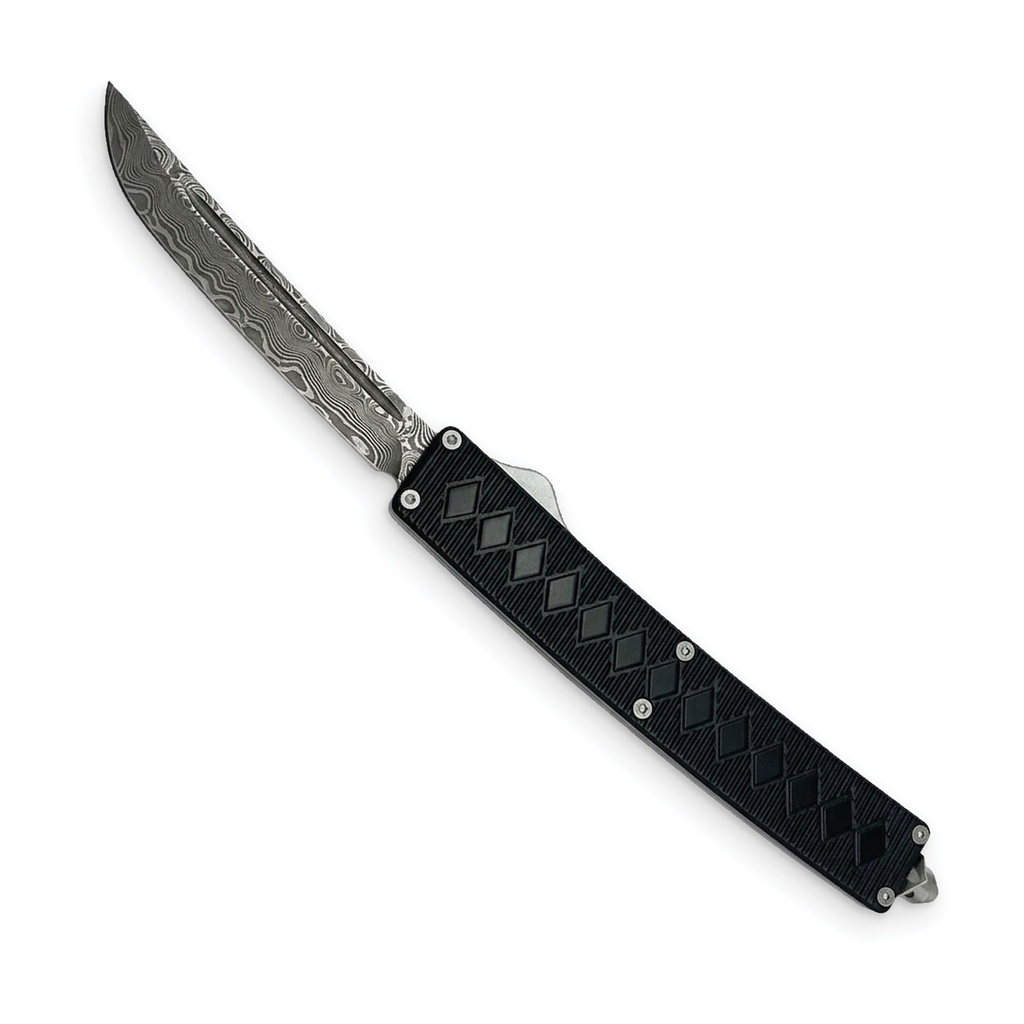
The Damascus Current OTF Knife sends its blade through the front of a matte-black handle using a thumb slide. It’s an automatic knife with a front-opening path, rather than a side-opening switchblade. Silver-gray Damascus-pattern lines meet a Japanese tanto profile and a katana-style diamond grip. For your Texas knife rotation, the 5-inch closed length, pocket clip, and MOLLE nylon sheath give you practical details to consider alongside the design. It earns a place through a recognizable pattern and a mechanism you can name correctly.
| Blade Length (inches) | 3.5 |
| Overall Length (inches) | 8.5 |
| Closed Length (inches) | 5 |
| Blade Color | Silver |
| Blade Finish | Damascus pattern |
| Blade Style | Japanese Tanto |
| Blade Edge | Plain |
| Handle Finish | Matte |
| Button Type | Slide |
| Theme | Damascus |
| Pocket Clip | Yes |
| Sheath/Holster | MOLLE nylon |
The Damascus Current OTF Knife is a slide-operated automatic knife whose blade travels through the front of the handle. That opening path sets it apart from a side-opening automatic, while both belong in the broader switchblade conversation. Here, the mechanism shares attention with the design: silver-gray Damascus-pattern lines across a Japanese tanto blade, a long fuller, and a matte-black handle marked with repeating diamonds. You get a recognizable front-opening format with a visual identity that carries from blade to grip.
Damascus Current OTF Knife: Flow Against Geometry
The blade pattern does the first bit of talking. Its closely spaced lines flow across the silver-gray face, giving the exposed blade movement even when it is resting still. Against that, the handle stays orderly: straight sides, recessed diamonds, and fine diagonal grooves. The contrast works because the colors stay restrained. There is enough detail to hold your attention without several unrelated finishes competing for it.
The Japanese tanto profile continues that design language. Its tip follows a curved transition rather than the sharply angular secondary point associated with an American tanto. The plain cutting edge keeps the blade outline uninterrupted, while the long recessed fuller adds another line along the blade face. For a collector, those details make this OTF knife more specific than simply a patterned blade in a black handle.
The katana-inspired grip is a visual reference expressed through the handle itself. Repeating diamond recesses suggest traditional wrapping without changing the long, rectangular outline needed for this front-opening format. Silver-colored screws supply small points of contrast along the black surface.
How This OTF Knife Opens—and Where Automatics Fit
A thumb slide and a front-opening blade path
The projecting thumb slide is the operating control. This OTF knife deploys its blade through the handle’s front opening instead of swinging it around a pivot at one end. That is the defining distinction behind the words out-the-front. The blade’s direction of travel matters more to the category than the decorative pattern, tip shape, or handle styling.
At 8.5 inches overall, with a 3.5-inch blade and a 5-inch closed length, the knife gives you concrete dimensions to compare with the pieces you already own. Those measurements are more useful than calling it small or large. Lay a familiar knife beside a ruler, and you have a sensible starting point for deciding how this format fits your rotation.
Automatic, switchblade, and assisted are not three interchangeable labels
An automatic knife uses a spring-operated mechanism activated by a control. Switchblade is a common term for that broad family. An OTF describes the blade’s front-opening travel; a side-opening automatic describes a different path within the automatic category. This knife brings the automatic mechanism and the out-the-front layout together.
An assisted opener works differently: you begin opening the blade manually before the spring assists the movement. That distinction matters when comparing controls and handling. A thumb-operated part alone does not make every knife mechanically alike. Knowing what starts the blade moving, and where it goes, keeps the comparison honest.
Carry Proportions for a Texas Knife Rotation
The 5-inch closed length is worth considering before you choose a place for it. Measure the pocket or compartment you normally use, especially if you already carry other everyday gear. The pocket clip provides a pocket-carry option, while the MOLLE nylon sheath offers a separate way to organize the knife with compatible gear.
Choose between those options according to your routine, not the photograph. A clip and a sheath solve different storage and access problems. Neither changes the knife’s dimensions. Keeping that distinction in mind helps you choose a setup that suits your day rather than rearranging everything around a new acquisition.
For Texas buyers, the legal question deserves the same plain treatment as the mechanism question. Laws on this type of product vary by state and city. Check the law where you live and carry.
Collector Details Beyond the Blade Pattern
A collection becomes more interesting when each addition has a reason to be there. This one brings together a Japanese tanto profile, a Damascus-pattern finish, a katana-style grip, and slide-action deployment. Those are separate design choices, but the restrained black-and-silver palette gives them a common thread.
Look closely at the relationship between the fuller and the flowing blade lines. One is a long, deliberate recess; the others form the decorative surface pattern around it. The difference gives the blade face structure. On the handle, the recessed diamonds repeat that balance between a clear underlying shape and smaller surrounding details.
The plain edge is another useful point of comparison. There are no serrations interrupting its lower cutting edge. If your drawer already holds serrated blades, brightly colored handles, or angular American tanto profiles, this knife introduces a different combination without relying on another color to distinguish itself.
That is a sound collector’s question to ask of another OTF knife: what does it add? Here, the answer is a coordinated pattern language across a familiar mechanical format. Buy it for that combination, and the reason for owning it remains clear after the first look.
What Texas Buyers Ask About OTF Knife
Is an OTF knife different from an automatic knife or a switchblade?
The terms overlap. OTF describes a blade that travels through the front of its handle. This slide-action model is an automatic knife, and switchblade is a common term for the broader automatic family. A side-opening automatic swings outward instead.
Can I carry this OTF knife in Texas?
Laws on this type of product vary by state and city. Check the law where you live and carry.
What makes this a worthwhile addition to my collection?
The combination is the draw: flowing Damascus-pattern lines, a curved Japanese tanto tip, geometric grip detailing, and a matte-black handle. Compare its 5-inch closed length with your usual carry, then decide whether that design fills a place in your rotation.
A Texas knife collection does not need every piece to make the same argument. The Damascus Current earns consideration through its front-opening mechanism and connected visual details. If you know your knives, you can appreciate both—and explain the difference without making a speech.