Denim Workday Spring Assisted Knife - Blue Aluminum
14 sold in last 24 hours
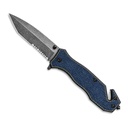
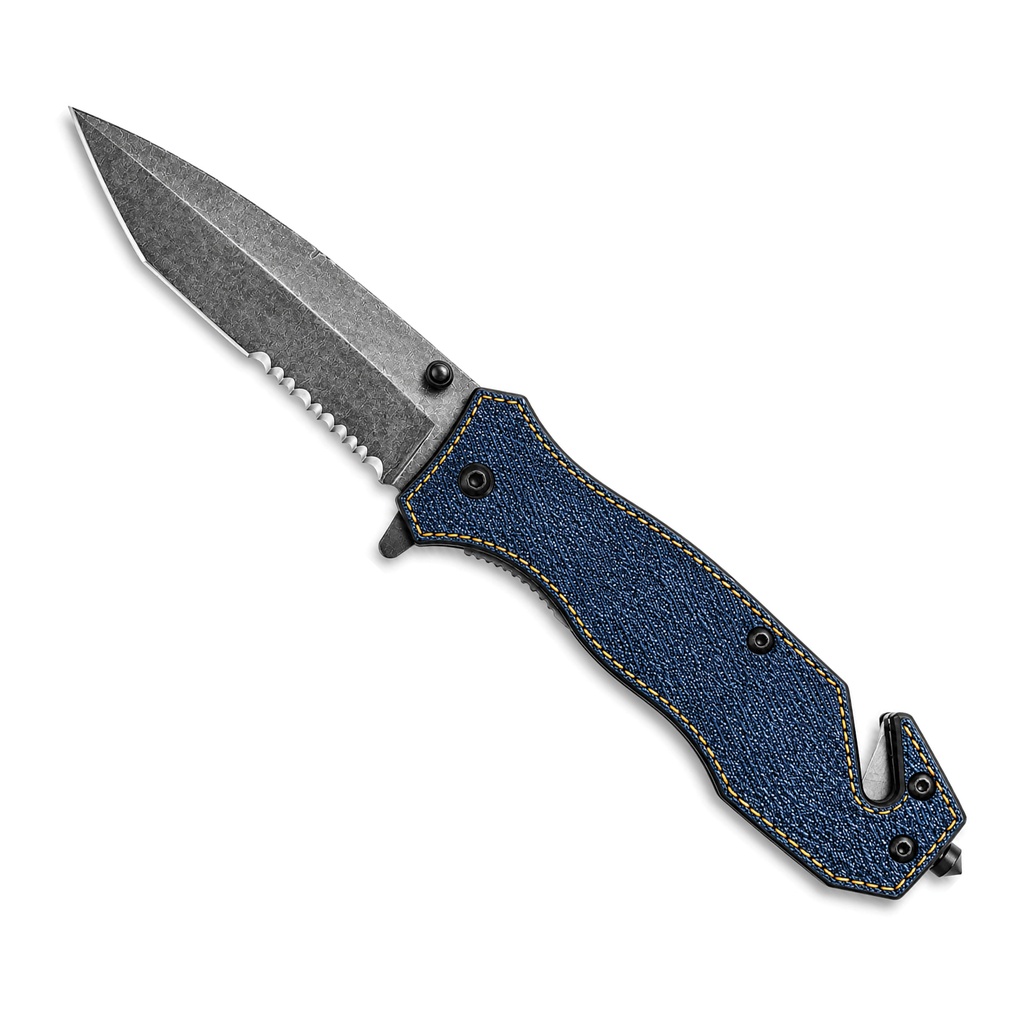
The Denim Workday Spring Assisted Knife starts with your hand; spring assistance completes the opening. Its blade folds from the side, not through the handle like an OTF knife, and its manual start separates it from an automatic knife or switchblade. Blue textured aluminum and yellow stitch-style markings carry the workwear theme without using actual fabric. With a 3.5-inch partially serrated tanto blade, pocket clip, and liner lock, it fits the jeans-and-workbench side of Texas collecting: familiar materials, useful details, and a mechanism you know by name.
| Blade Length (inches) | 3.5 |
| Overall Length (inches) | 8 |
| Closed Length (inches) | 4.5 |
| Blade Color | Black |
| Blade Finish | Stonewashed |
| Blade Style | American Tanto |
| Blade Edge | Partial-Serrated |
| Blade Material | 8Cr13MoV stainless steel |
| Handle Finish | Textured |
| Handle Material | Aluminum |
| Theme | Denim |
| Pocket Clip | Yes |
| Deployment Method | Spring-assisted |
| Lock Type | Liner lock |
Spring Assisted Knife With Denim Workday Character
The Denim Workday Spring Assisted Knife is a side-folding knife with a manual start and spring-assisted follow-through. You begin moving the blade; the spring helps complete its opening arc. That distinction matters more than the workwear styling, though the styling earns a second look. Blue aluminum carries a diagonal denim-like texture, yellow stitch-style markings trace the handle, and black hardware keeps the whole arrangement grounded. It looks familiar beside a pair of jeans because that is exactly where its design language comes from.
The handle is aluminum, not fabric. Its textured surface supplies the visual grain, while the yellow perimeter gives the impression of a sewn pocket edge. Against that blue-and-yellow pattern sits a black stonewashed blade with lighter, mottled markings. The contrast is deliberate: an everyday clothing reference on one side, a plainly recognizable cutting tool on the other. Neither detail needs an invented backstory to make sense.
Assisted Opening, Automatic Knives, and OTF Travel
A manual start, followed by spring assistance
A thumb stud and flipper tab provide blade-mounted opening controls. With this assisted mechanism, your input starts the blade moving before the spring takes over the remaining travel. That is different from an automatic knife, where operating a release activates spring-powered deployment. Switchblade is a common term for an automatic; it is not a better name for every folder that opens with help from a spring. This one belongs in the assisted-opening category.
Blade direction and activation are separate questions
An OTF knife sends its blade out through the front of the handle rather than swinging it around a pivot. OTF describes the blade’s travel; automatic describes how deployment is activated. Those categories can overlap. The Denim Workday instead opens from the side and requires manual blade initiation. Understanding those two points keeps an automatic knife vs OTF knife comparison useful rather than turning unlike mechanism descriptions into competing labels.
Once the blade is open, a liner lock holds it in position. Closing requires disengaging that lock and folding the blade back into the handle. Keep your fingers clear of the cutting edge and closing path. The flipper tab sits behind the blade when open, above a curved finger recess in the handle. Visible ridges along the forward liner add another tactile detail around that transition.
Tanto Steel and the Details You Carry
The 3.5-inch blade uses 8Cr13MoV stainless steel and an American tanto profile. Its angular tip meets the main cutting edge at a distinct corner rather than following one continuous belly. That geometry gives the blade its unmistakable outline. The partial serrations sit nearer the handle, leaving plain cutting sections toward the tip. You get two edge configurations on the same blade, not a fully serrated cutting edge.
The plain sections suit controlled slicing through ordinary packaging, while the serrated section offers a different cutting action for fibrous material. Each section also asks for attention during sharpening: the straight cutting portions and individual serrations do not share the same maintenance approach. For a collector accustomed to plain-edge drop points, that combination adds a meaningful difference beyond another handle color.
The knife measures 8 inches overall and 4.5 inches closed. Those dimensions put its workwear appearance in perspective: this is a substantial folding format, not a tiny novelty built around a denim graphic. A pocket clip provides a way to secure it at a pocket opening. Check how the closed handle sits against your usual pocket depth, especially where the tools at the butt meet the pocket seam.
A recessed strap cutter occupies a hooked opening near the handle butt, and a short pointed glass breaker projects from the end. These are separate features from the main blade. Their presence broadens the tool layout, but neither changes the opening mechanism or the blade’s purpose as a cutting tool. Keep the hooked opening and exposed point in mind when handling, storing, and positioning the closed knife.
A Place in a Texas Knife Collection
Texas workwear does not need much explanation. Denim belongs around shop benches, weekend repairs, and the everyday business of getting outside. This handle borrows that familiarity without pretending to be a handmade leather piece or a fabric-covered traditional folder. Aluminum, visible screws, a thumb stud, and a flipper tab make its construction plainly contemporary. The yellow border supplies the character; the mechanical details keep it from being only a pattern.
Within a collection, the Denim Workday makes sense beside knives with different opening systems. An automatic knife demonstrates release-activated deployment. An OTF knife demonstrates frontward blade travel. This assisted folder demonstrates a manually initiated opening arc with spring help. Put them together and the distinctions become tangible. The switchblade label belongs where the mechanism supports it, not wherever a blade happens to open briskly.
Regular care remains straightforward in principle: remove cutting residue, dry the blade after cleaning, and keep debris out of the pivot and lock area. Stainless steel still benefits from attention. The stonewashed finish contributes a mottled appearance, but the cutting edge and moving parts deserve the same care you would give any working folder. A recognizable theme is worth keeping clean enough to enjoy.
What Texas Buyers Ask About Spring Assisted Knife
Is this an OTF, an automatic, or a switchblade?
No. This spring assisted knife requires you to begin opening the blade manually, and the blade swings out from the side. It is not an OTF knife. An automatic knife uses a release to activate deployment, and switchblade commonly refers to that automatic mechanism. The distinction here is the manual start, not the presence or absence of a spring.
What should I know about carrying this knife in Texas?
Laws on spring-assisted knives vary by state and city. Check the law where you live and carry, including in Texas.
What makes this one worth adding beside other assisted folders?
The combination is specific: denim-patterned blue aluminum, yellow stitch-style accents, a black stonewashed American tanto blade, and a partially serrated edge. The strap cutter and glass breaker add separate tool features at the butt. Choose it when that workwear design and combo-edge configuration fill a real gap in your collection, rather than expecting a different deployment system beneath the styling.
A Texas collection can make room for both mechanical variety and a little familiar character. The Denim Workday brings its own identity without borrowing an automatic’s name or an OTF’s blade path. It is an assisted folder with a denim point of view—an honest fit for someone who knows what opens, how it opens, and why that particular knife belongs in the drawer.