Duty-Link Precision Hinged Handcuffs - Nickel
15 sold in last 24 hours
These Smith & Wesson hinged handcuffs bring duty-grade control to Texas law enforcement, security, and serious collectors. The rigid hinge limits wrist movement, while smooth ratchets and a reliable double-lock mechanism keep restraint swift and secure. Nickel-finished carbon or stainless steel and heat-treated lockworks are built to stand up to real Texas shifts, not costume duty. For the buyer who respects NIJ-tested gear and knows the difference between novelty and professional restraint, these cuffs belong on the belt and in the collection.
Smith & Wesson Hinged Handcuffs Built for Texas Duty
Smith & Wesson hinged handcuffs in nickel are not toys, not props, and not weekend novelties. They are professional restraints built on a rigid hinge that keeps a subject's wrists where you put them. If you work a Texas street, run private security, or keep a serious law-enforcement collection, you can see that difference at a glance. These cuffs are about control, compliance, and reliability under pressure.
Where some gear leans flashy, these nickel Smith & Wesson handcuffs stay all business: smooth ratchets for quick application, a double-lock system to prevent over-tightening and tampering, and heat-treated internals that have to pass demanding U.S. National Institute of Justice standards. That NIJ testing separates real duty tools from novelty restraints the same way a true automatic knife stands apart from a gas-station special.
Hinged Handcuffs vs. Chain Cuffs: Control as the Mechanism
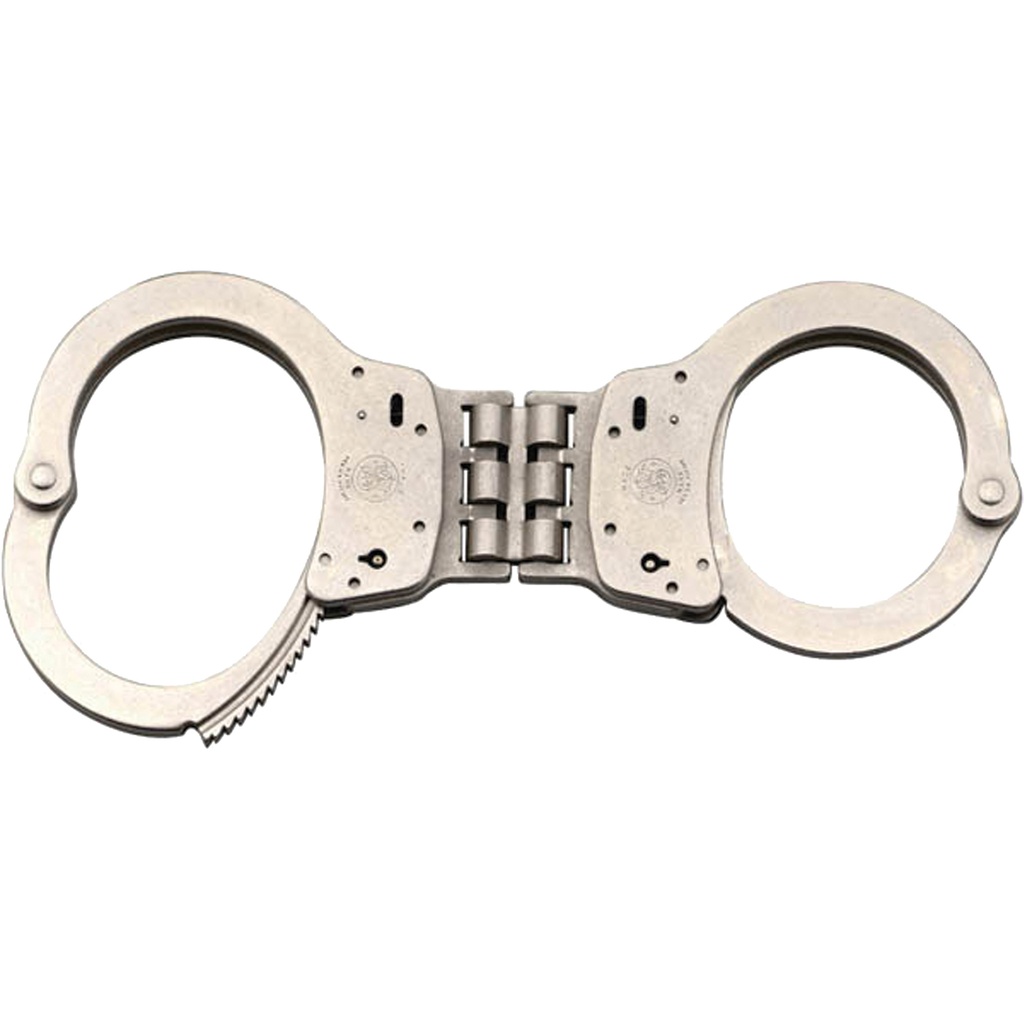
The first thing any experienced Texas officer or collector notices here is the hinge. Instead of a loose chain between the bracelets, you get a rigid three-link hinge that sharply limits wrist rotation. That tighter control changes how these handcuffs feel in the hand and how a subject can move once they're on.
Chain cuffs give a little slack, which can be useful for transport or long-duration restraint. Hinged handcuffs, like this Smith & Wesson nickel set, are about leverage. When you apply them during an arrest or a high-risk detention, that rigid spine between the cuffs lets you manage resistance more efficiently and keeps the subject from spinning or twisting as easily. It's a mechanical decision, not a cosmetic one, and well worth understanding if you depend on your gear under Texas heat and pressure.
Double Lock Mechanism for Real-World Security
These Smith & Wesson hinged handcuffs feature a double lock slot configuration on each cuff. Once you've applied the cuffs and checked fit, you engage the double lock with the tip of the key. That prevents the ratchet arm from tightening further, protecting the subject from nerve damage or unnecessary injury while also making shimming or manipulation far more difficult.
For a working Texan, that double lock function is the restraint equivalent of a safety you can actually trust. Like carrying the right automatic knife with a positive safety instead of a loose-pocket folder, it means the tool behaves the same way every time you use it.
Heat-Treated Lockworks and Nickel Finish
Smith & Wesson builds these hinged handcuffs from high-quality carbon or stainless steel with heat-treated internal lockworks. That heat treatment hardens the working parts, improving strength and tamper resistance so the cuff holds up to real-life use instead of desk-drawer duty. The nickel finish gives the steel a clean, authoritative silver look while adding a measure of corrosion resistance — important if your work or collection lives in Texas humidity, dust, and sweat.
Texas Use: From Street Duty to Serious Collections
In Texas, the line between working gear and collectible gear is often thin. A lot of buyers wear what they collect and collect what they trust. These Smith & Wesson hinged handcuffs sit comfortably in that overlap. They're NIJ-tested duty restraints built for officers, deputies, constables, jail staff, and professional security who need rigid cuffs that don't quit halfway through a career.
Collectors, on the other hand, appreciate the hinged design as a distinct mechanism in its own right. Just like one shelf might separate automatic knives from OTF knives and traditional switchblades, a serious restraint collection draws lines between chain, hinged, and rigid cuffs. This nickel hinged model gives you that classic law-enforcement profile with a clear design story: more control, less give, and a finish that looks right next to other duty-grade Smith & Wesson pieces.
Texas Law, Professional Carry, and Responsible Ownership
Texas law treats handcuffs differently from edged weapons. Where Texas knife statutes spell out how you can carry an automatic knife, an OTF knife, or a classic switchblade, professional restraints like these Smith & Wesson hinged handcuffs are generally tools of the trade. Law-enforcement officers, licensed security, and related professionals carry them as part of their duty gear. Private citizens may legally own and collect cuffs in Texas, but using them outside of lawful, consensual, or professional contexts can lead to serious criminal charges.
If you work in Texas law enforcement or security, these hinged handcuffs fit right into a patrol belt or duty rig, alongside whatever automatic knife or backup blade your department policy allows. If you're a Texas collector, they belong in the case with other real-world tools, not gimmicks. Either way, you treat them as serious equipment, not conversation pieces.
Mechanism Mindset: Why Knife Collectors Respect These Cuffs
This site speaks to buyers who already care about mechanism. You know the distinction between a side-opening automatic knife, a dedicated OTF knife, and a traditional switchblade, and you expect that same mechanical honesty in everything you buy. These Smith & Wesson hinged handcuffs scratch that same itch — the hinge is a deliberate mechanical choice that changes leverage, control, and how the tool works in the hand.
Think of it this way: a chain cuff is to a basic folder what hinged cuffs are to a tight-locking automatic knife. Both will get the job done, but the upgraded mechanism gives you more predictability, more control, and a clearer purpose. That clarity is what Texas collectors tend to look for, whether they're adding a new automatic knife, an OTF, a switchblade, or, in this case, a professional-grade pair of hinged handcuffs to the mix.
NIJ Testing: The Restraint Version of Proven Steel
Knife people talk steel. Restraint people talk testing. These Smith & Wesson hinged handcuffs meet or exceed U.S. National Institute of Justice standards for workmanship, strength, corrosion resistance, and tamper resistance. In collector language, that's the equivalent of knowing your blade steel, heat treat, and grind all came together the right way. It means these cuffs were built to hold up, not just hold on.
What Texas Buyers Ask About Smith & Wesson Hinged Handcuffs
How do hinged handcuffs compare to other restraint types?
Hinged handcuffs trade flexibility for control. Where chain cuffs allow more wrist rotation and a bit of comfort during transport, hinged cuffs sharply limit movement and give the officer more leverage to manage resistance. That difference is mechanical, just like the gap between an OTF knife and a side-opening automatic knife. Same broad purpose, different deployment and control. For Texas professionals who routinely deal with non-compliant subjects, that added control is often worth the switch to a hinged design.
Are these hinged handcuffs legal to own in Texas?
Yes. Texas law does not ban the ownership of handcuffs, including professional hinged handcuffs like this nickel Smith & Wesson set. Law enforcement officers, jail staff, and licensed security carry them as duty tools. Private citizens in Texas can purchase and own handcuffs as collectible items or for lawful, consensual use. The legal trouble comes from how and why they are used — unlawful restraint, impersonating an officer, or using cuffs in a crime will bring serious charges. Treat them with the same respect you’d give a serious automatic knife or any other professional tool.
Why would a collector choose hinged cuffs over standard chain cuffs?
A collector who already separates automatic knives from OTF knives and classic switchblades tends to appreciate clear mechanical differences. Hinged handcuffs offer a visibly and functionally distinct mechanism compared to chain cuffs: tighter control, a more compact profile, and a very different handling feel. Add the Smith & Wesson name, nickel finish, and NIJ-tested construction, and you have a restraint that represents a specific era and style of professional use — exactly the kind of piece that earns its space in a Texas law-enforcement or tactical collection.
Built for the Belt, Worthy of the Case
These Smith & Wesson hinged handcuffs in nickel are the kind of tool Texans tend to favor: simple, strong, and honest about what they do. They’re made for real duty work but refined enough in execution to belong in a serious collection alongside your best automatic knife, your favorite OTF knife, and that one switchblade you only hand to people who understand it.
If you live and work in Texas and care about mechanisms, this pair makes sense. They offer a clear upgrade in control over basic chain cuffs, backed by a maker you already know from firearms and duty gear. No drama, no flash — just a set of hinged handcuffs that does its job so well you hardly have to talk about it at all.