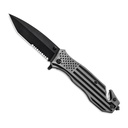
Monochrome Flag Tanto Spring Assisted Knife - Gray Aluminum
15 sold in last 24 hours
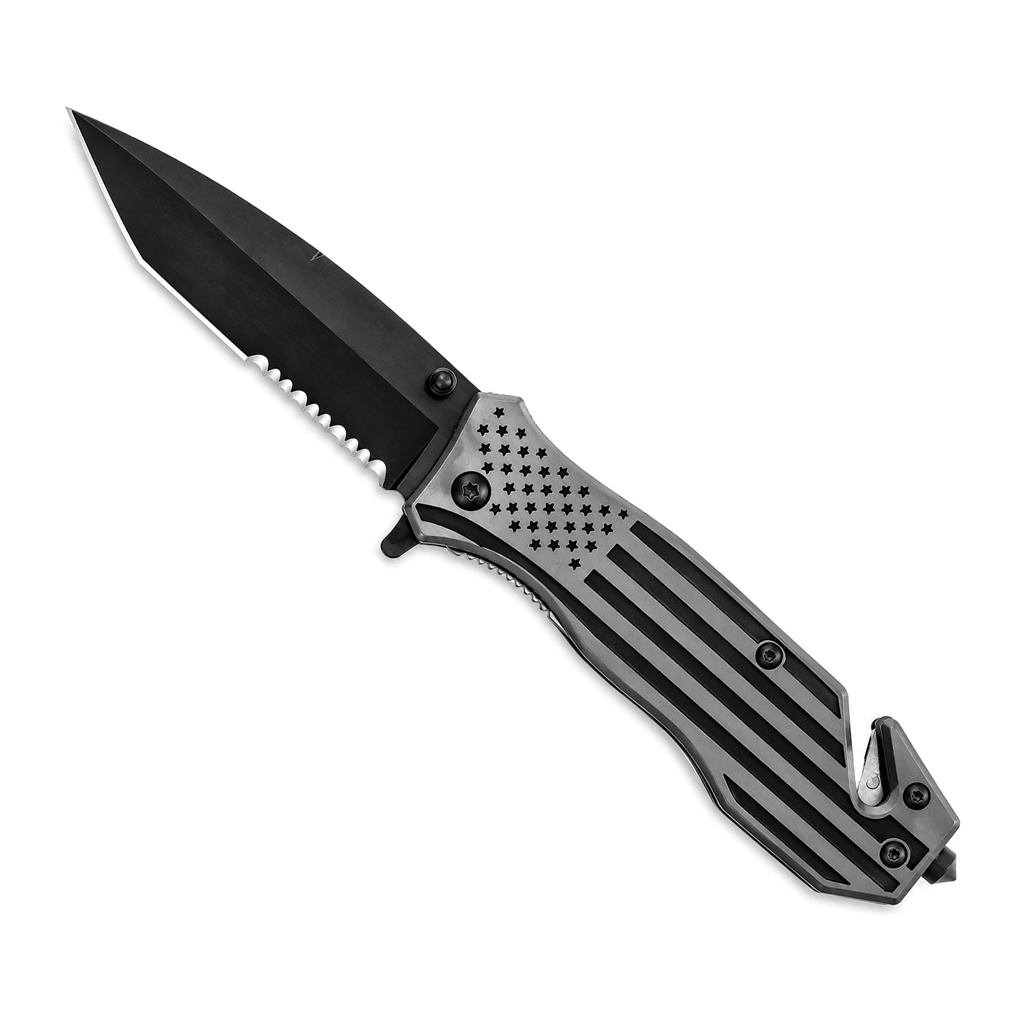
This spring assisted knife opens with your manual input before the spring takes over, pairing a partially serrated tanto blade with a stonewashed gray aluminum flag handle. It is an assisted folder, not an automatic knife or automatic OTF knife—the distinction matters more than the switchblade shorthand. For a Texas day split between the workbench and ordinary errands, the pocket clip keeps it close. Black stars, long stripes, and a silver cutting edge give your rotation a recognizable piece without turning up the volume.
| Blade Length (inches) | 3.375 |
| Overall Length (inches) | 7.875 |
| Closed Length (inches) | 4.5 |
| Blade Color | Black |
| Blade Finish | Matte |
| Blade Style | American Tanto |
| Blade Edge | Partial-Serrated |
| Blade Material | 8Cr13MoV stainless steel |
| Handle Finish | Stonewashed |
| Handle Material | Aluminum |
| Theme | USA Flag |
| Pocket Clip | Yes |
| Deployment Method | Spring-assisted |
| Lock Type | Liner lock |
This spring assisted knife starts with your hand, not a release button. Move the blade through the beginning of its opening travel, and spring assistance helps finish the job. That makes it an assisted folding knife rather than an automatic knife. The distinction is straightforward; the design has a little more to say. Black stars sit near the pivot, long stripes run toward the butt, and a matte black American tanto blade balances the stonewashed gray aluminum handle. It is a flag-themed folder with working details behind the pattern.
How This Spring Assisted Knife Opens
The black thumb stud and flipper tab give you two blade-mounted starting points. Both belong to the same mechanical story: you begin moving the blade, then the spring assists the opening. Neither turns the knife into a button-fired automatic. If you keep several opening systems in your drawer, that difference is worth preserving in the names you use.
Manual Start, Spring-Assisted Finish
An assisted opener bridges manual input and spring-driven movement. Here, the visible thumb stud sits near the pivot, while the flipper tab projects below the handle. Try either method deliberately, keeping fingers clear of the blade path. Familiarity matters more than speed, especially when moving between folders with different opening controls.
A Liner Lock Behind the Blade
Once the blade is open, the liner lock holds it in its working position. Closing requires moving the locking liner aside before folding the blade into the handle. Keep your fingers outside the closing path. The ridged liner section near the forward finger recess gives this part of the knife a distinct texture without adding another external control.
A Tanto Blade With Two Working Edges
The 3.375-inch blade uses 8Cr13MoV stainless steel and an American tanto profile. Its angular tip comes from two straight cutting-edge sections meeting at a pronounced corner. That geometry looks different from a sweeping drop point because it is different: you have a main cutting section and a separate forward section to place against the work.
Partial serrations sit nearest the handle, leaving the forward edge plain. The serrated portion gives you an option for fibrous material such as cord, while the plain section suits controlled cuts through packaging. Choose the section that fits the task rather than treating the whole edge as interchangeable. When sharpening, preserve the tanto's corner instead of rounding it into a continuous curve.
The matte black blade faces meet a contrasting silver cutting edge. That contrast makes the shape easy to read and echoes the black graphics on the gray handle. Stainless steel still benefits from ordinary care: wipe away residue, dry the blade after moisture exposure, and keep the pivot area clear of debris. Simple habits do more for a working folder than ambitious promises.
Spring Assisted Knife vs. Automatic Knife and OTF Knife
These terms describe different things. An automatic knife opens through stored energy when you operate its release control. An assisted folder requires you to initiate blade movement before assistance takes over. This knife belongs to the second group. A thumb stud alone does not settle the question; what matters is how the opening mechanism actually works.
An OTF knife sends its blade out through the front of the handle. OTF describes the blade's travel, not simply the presence of a spring. An automatic OTF combines that front-exiting layout with automatic operation. This blade instead pivots out from the side of its handle, following the familiar arc of a folding knife.
Switchblade commonly refers to an automatic knife in everyday conversation. It is not a useful catchall for every folder that opens briskly. For a collector, keeping those distinctions straight makes the collection more interesting: an assisted side-opening folder, a side-opening automatic, and an automatic OTF represent different mechanisms, even when their blade finishes or handle colors look similar.
Gray Flag Detail for a Texas Carry Rotation
At 4.5 inches closed and 7.875 inches overall, this folder gives you concrete dimensions to compare with knives you already carry. The pocket clip provides a way to position it in a pocket rather than leaving it loose among keys. Consider the closed length against your usual work pants or jeans; pocket depth matters more than a photograph can suggest.
The aluminum handle has a mottled, stonewashed finish with beveled outer edges. Its curved finger recess sits behind the flipper tab. Black pivot and handle screws keep the hardware visually tied to the flag graphic and blade. For a Texas collector who likes patriotic styling without bright colors, the appeal is in that consistent treatment rather than an oversized emblem.
Separate Tools at the Handle Butt
A seat belt cutter sits inside a hooked recess near the butt, with its edge sheltered within the opening. A short glass breaker projects from the rear. These are separate features, not additional functions of the tanto tip. Keep the cutter recess clear of debris, and account for the projecting breaker when deciding how the knife sits in your pocket or storage tray.
What Texas Buyers Ask About Spring Assisted Knife
Is this an OTF, an automatic, or a switchblade?
It is a spring assisted knife with a side-opening blade. You start blade movement manually; the spring then assists. It is not an OTF knife, because the blade pivots rather than exiting through the front. It is not an automatic knife, so switchblade is not the right everyday description for this mechanism.
Can I carry this spring assisted knife in Texas?
Laws on this type of product vary by state and city. Check the law where you live and carry, including the Texas locations you visit.
What makes it worth adding to a collection?
The combination is specific: monochrome flag graphics, stonewashed aluminum, a partially serrated American tanto, and two rear utility features. Choose it if those details fill a place in your rotation. If you prefer a continuous curved edge or front-exiting deployment, those are different designs worth recognizing before you decide.
A good Texas knife collection does not need every piece to tell the same story. This one brings a manual-start assisted mechanism, an angular working blade, and subdued flag detail. Give it a place because you understand that combination—not because every spring-powered folder gets called the same thing.