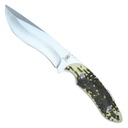
Frontier Curve Heritage Hunting Knife - Stag Handle
13 sold in last 24 hours
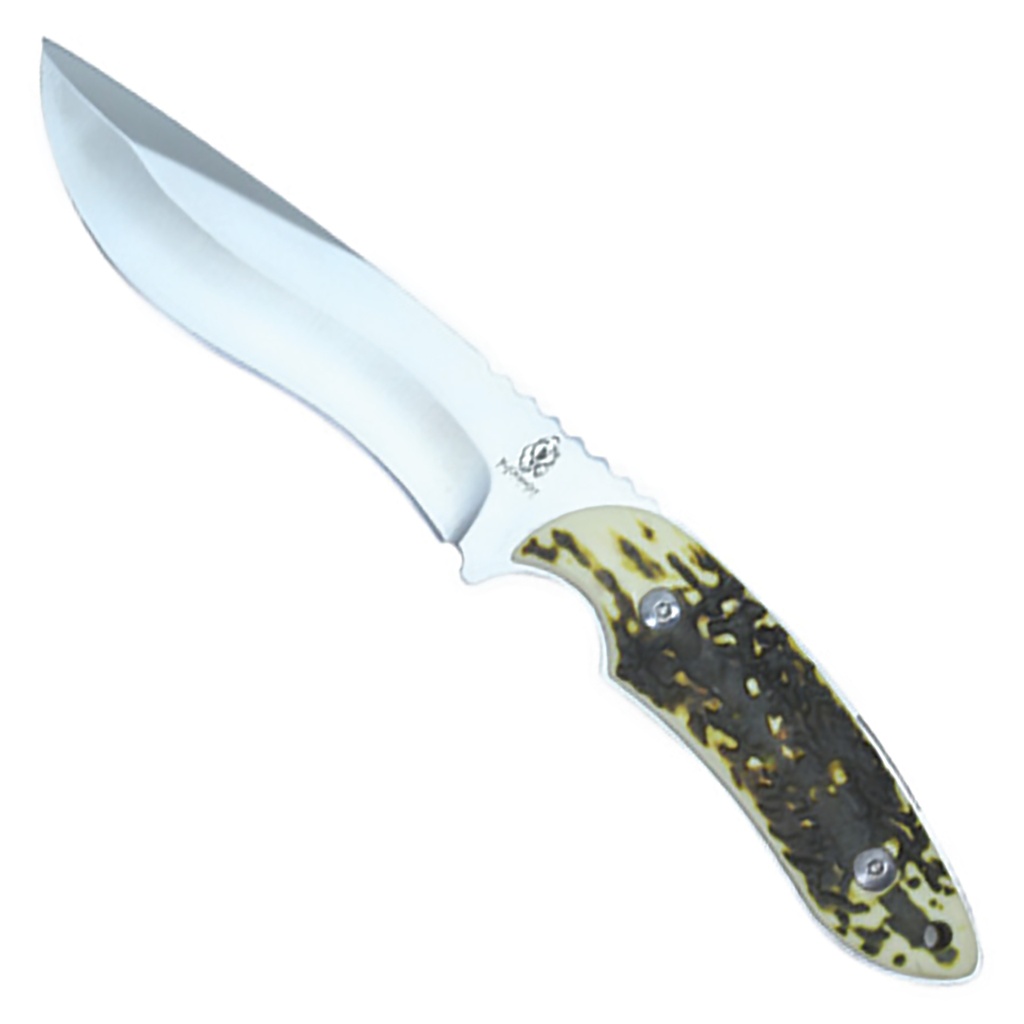
This full-tang hunting knife is built for Texans who still work a deer on the tailgate. The Frontier Curve Heritage Hunting Knife rides easy on the belt in its nylon sheath, then disappears in the hand when it’s time to cut. A 5-inch trailing point blade glides through hide, while the stag handle locks into a natural grip. No springs, no gimmicks—just a fixed blade you can trust from camp chores to clean, confident field dressing.
| Blade Length (inches) | 5 |
| Overall Length (inches) | 9.5 |
| Blade Color | Silver |
| Blade Finish | Polished |
| Blade Style | Trailing Point |
| Blade Edge | Plain |
| Blade Material | Steel |
| Handle Finish | Polished |
| Handle Material | Stag |
| Theme | None |
| Handle Length (inches) | 4.5 |
| Tang Type | Full Tang |
| Carry Method | Belt Carry |
| Sheath/Holster | Nylon Sheath |
What the Frontier Curve Heritage Hunting Knife Really Is
The Frontier Curve Heritage Hunting Knife is a classic fixed blade hunting knife with a full-tang spine and a real stag handle. No springs hidden in the frame, no button to push, no automatic knife tricks—just solid steel you can see from pommel to tip. For a Texas hunter or collector, that matters. This is the kind of knife that lives on a belt all season, not in a display case.
Where an automatic knife or switchblade is built around fast deployment, this fixed blade is built around what happens after it’s already in your hand. You don’t flip it, you don’t fire it, you just draw it from the sheath and start cutting. In the field, that simplicity is its own kind of speed.
Fixed Blade Hunting Knife Mechanics, Texas-Plain
This is a true full-tang fixed blade hunting knife. The tang runs the full length and width of the handle, with stag scales pinned on both sides. You can see the steel all the way around the handle profile—that’s your proof it isn’t hiding anything and won’t surprise you under torque.
The 5-inch trailing point blade gives you that sweeping belly Texas hunters like for skinning and field dressing. The polished steel helps resist gunk sticking, and the thumb jimping on the spine near the handle lets you choke up for tight, careful work. At 9.5 inches overall, the balance point sits right where your first finger finds the groove in the stag handle, so it tracks naturally through hide and meat instead of fighting you.
Compared to an OTF knife or a side-opening automatic, this hunting knife doesn’t deploy—it’s already deployed. There’s no internal track, no spring to tune, and no risk of grit fouling the mechanism during a dusty Texas season. When you’re working a hog in the dark or skinning a deer in camp, that lack of moving parts is exactly what you want.
How This Hunting Knife Differs from an Automatic Knife or Switchblade
If you collect all three—automatic knives, OTF knives, and fixed blades—you know they each earn their spot for different reasons. This Frontier Curve is not an automatic knife and not a switchblade. There’s no button, no coil spring, no assisted opening of any kind. It’s a straightforward fixed blade hunting knife that rides in a sheath until you need it.
An OTF knife sends the blade straight out of the handle on a track; a switchblade or side-opening automatic knife swings the blade out from one side under spring tension. Both are about deployment speed and one-handed use. This hunting knife is about control once the cutting starts: that curved trailing point, plain edge, and full-tang spine give you predictable, repeatable cuts through hide, joint, and sinew. For a Texas collector, that makes it the working counterpart to the autos in the drawer.
Texas Carry, Camp Reality, and the Frontier Curve
In Texas, a fixed blade hunting knife like this Frontier Curve fits naturally into the way folks actually live. It’s built for belt carry in a nylon sheath, from the trailhead to the tailgate. You’re not flipping it open at the office or clicking it in a truck stop parking lot—you’re sliding it out at camp when there’s real work to do.
Where automatic knives and OTF knives invite questions about mechanism and legality, this straightforward fixed blade hunting knife usually reads as what it is: a field tool. It’s the knife you wear over a jacket on a cold Panhandle morning, the one you set on the cutting board next to the backstrap, and the one you rinse off in the creek before you head home. For Texas buyers, that quiet practicality is as important as any showpiece switchblade in the collection.
Blade Geometry for Real Field Use
The trailing point shape on this hunting knife isn’t decoration. That upswept tip and long belly are tuned for skinning and long sweeping cuts. The plain edge lets you sharpen it easily on a stone in camp, without fighting serrations. Thumb jimping gives you a solid purchase when you’re bearing down, and the finger groove at the front of the stag handle keeps your hand locked in even when things get slick.
Full-Tang Strength and Stag Handle Character
Because this is a full-tang fixed blade, you can baton through small limbs, pry a little when you absolutely have to, and twist the blade in tough connective tissue without wondering what’s happening inside a pivot. The stag handle scales bring texture and character—no two pieces look the same—so every Texas collector ends up with a hunting knife that has its own grain and story. Over time, the stag darkens and smooths where your fingers live, giving it the kind of patina an automatic knife or OTF rarely earns.
Collector Value for Texas Knife Buyers
For a serious Texas knife collector, this Frontier Curve Heritage Hunting Knife fills a different slot than your favorite switchblade or OTF knife. It’s the traditional fixed blade that explains why the other knives exist. Before folks were debating automatic knives versus assisted openers, they were carrying full-tang hunting knives with stag handles just like this one.
That makes it an anchor piece in a collection. You can lay it out next to a high-end automatic knife and a double-action OTF and show, in one glance, how mechanism changes purpose. The fixed blade is the camp and field worker; the switchblade is the fast-deploy companion; the OTF is the precise, mechanical showpiece. For a Texas buyer who values accuracy in knife terms, owning a clear example of each type is part of telling the full story.
What Texas Buyers Ask About Hunting Knives
Is this hunting knife anything like an automatic knife, OTF, or switchblade?
No. This Frontier Curve is a true fixed blade hunting knife, not an automatic knife, not an OTF knife, and not a switchblade. There is no button, slide, or spring involved. The blade does not fold, fire, or retract; it stays fixed and ready in the sheath until you draw it. Collectors who already own OTF and automatic knives often add a full-tang hunting knife like this to round out their understanding of how simple, non-spring mechanisms work in the field.
How does a fixed blade hunting knife like this fit Texas law and carry?
Texas law distinguishes more by blade length and intent than by whether a knife is a fixed blade hunting knife, an automatic knife, or an OTF knife. This Frontier Curve is built as a hunting and camp tool for lawful outdoor use—belt carry in its sheath from lease to pasture and back. As with any knife in Texas—switchblade, automatic, OTF, or fixed—you’re responsible for knowing current state and local restrictions and using it as a legitimate tool, not as a weapon in prohibited settings.
Why would a collector choose this hunting knife over another fixed blade?
Because this one hits the classic notes cleanly: full-tang construction, a 5-inch trailing point blade tuned for field dressing, and a genuine stag handle with real texture. Where some fixed blade hunting knives chase tactical styling or mimic automatic knives with aggressive lines, the Frontier Curve leans into traditional Texas camp work. For a collector, it’s a straightforward reference piece that pairs naturally with more complex mechanisms like OTF knives and side-opening automatics in the same drawer.
In the end, the Frontier Curve Heritage Hunting Knife is for the Texan who knows an automatic knife when he sees one, appreciates a tight OTF mechanism, but still reaches for a fixed blade when there’s a deer hanging in camp. It’s a working hunting knife with enough heritage in its stag handle and full-tang spine to earn a place beside your switchblades and showpieces—proof that knowing your knives starts with the one that doesn’t need a spring to do its job.