Frontline 1918 Knuckle-Guard OTF Knife - Matte Black Metal
11 sold in last 24 hours
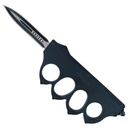
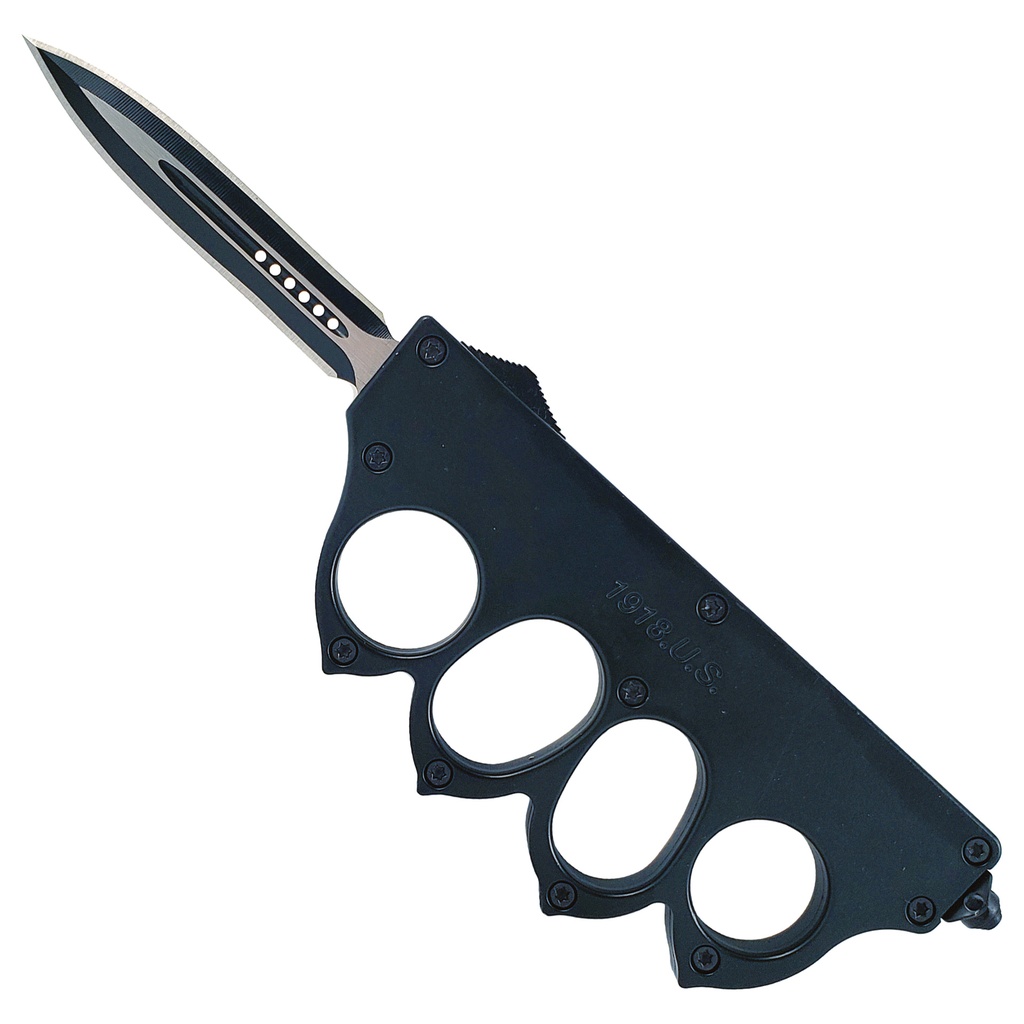
This 1918 heritage knuckle-guard OTF knife brings trench history into the automatic age. A full-metal, matte black handle with four-finger guard anchors a 3.25" double-edge dagger that fires straight out the front with a single-action slide. In Texas, it’s a bold desk piece, glovebox backup, or range companion for collectors who know the difference between an OTF knife, a side-opening automatic, and a switchblade—and want the trench classic done right.
| Blade Length (inches) | 3.25 |
| Overall Length (inches) | 9.375 |
| Closed Length (inches) | 5.875 |
| Weight (oz.) | 8.6 |
| Blade Color | Silver |
| Blade Finish | Matte |
| Blade Style | Dagger |
| Blade Edge | Plain |
| Blade Material | Steel |
| Handle Finish | Matte |
| Handle Material | Metal |
| Button Type | Switch |
| Theme | Trench |
| Double/Single Action | Single |
| Pocket Clip | No |
What This 1918 Heritage OTF Trench Knife Really Is
This 1918 Heritage Knuckle-Guard OTF Trench Knife is exactly what it looks like: a World War I trench silhouette rebuilt around a modern out-the-front automatic knife mechanism. The full-metal knuckle guard, the bold “1918 U.S.” on the handle, and the glass-breaker pommel all nod to the original trench knife, but the business end is pure OTF knife—double-edge dagger blade shooting straight out the front under spring power.
That’s the starting point for any serious Texas buyer. This isn’t a side-opening automatic and it isn’t a traditional pivoting switchblade. It’s a single-action OTF knife with a knuckle-guard handle, built for collectors who want historic trench styling with modern automatic speed.
OTF Knife Mechanism With Trench-Born Attitude
Mechanically, this piece is all about that single-action out-the-front deployment. The top-mounted thumb switch rides the spine of the handle; push it forward and the internal spring drives the 3.25-inch dagger blade out the front until it locks. You manually reset it afterward, but the jump from closed to ready is instant—that’s the defining experience of this automatic knife.
Single-Action OTF vs. Switchblade Feel
In hand, an OTF knife like this feels different from a switchblade or other side-opening automatic knife. A switchblade swings a blade out on a pivot; this trench-inspired OTF drives the blade in line with your grip, straight out the front. The motion is linear, the point is always centered, and you’re not clearing the blade around a handle. For Texas collectors who already own side-open automatics, that difference in deployment and control is exactly why an OTF belongs in the same case.
Dagger Blade Built for Direct Engagement
The double-edge dagger blade is matte silver steel with a central fuller that keeps it stout without feeling clumsy. Plain edges on both sides give you clean cuts in either orientation. It’s not a camp slicer, it’s not a hunting skinner—it’s a trench-style automatic built for direct, straight-line work, which is why the OTF knife mechanism and the knuckle guard make so much mechanical sense together.
Knuckle-Guard Trench Heritage, Modern Texas Reality
The first thing you feel is weight and presence: 8.6 ounces of matte black metal, four finger holes, squared frame, and that glass-breaker point at the base. In a world of slim EDCs, this is unapologetically full-size at 9.375 inches overall and 5.875 inches closed.
The knuckle-guard handle isn’t a gimmick. It locks your hand in place behind the OTF blade and anchors the automatic knife’s recoil when the spring kicks the dagger forward. The 1918 styling is faithful enough that anyone who knows trench knife history will recognize it at a glance, but the front-opening blade makes it clear this is a modern piece—not a reproduction of a fixed-blade original.
How Texas Collectors Actually Carry It
There’s no pocket clip here, and that’s intentional. This isn’t a jeans-pocket OTF the way a slim EDC automatic might be. In Texas it lives in a glovebox, on a ranch side-by-side, in a range bag, or in a nightstand. It’s the kind of automatic knife you bring out when someone asks about trench knives, OTF knives, or old-school switchblades and you want to show them something that connects all three worlds without pretending they’re the same thing.
OTF Knife, Automatic Knife, Switchblade: Where This One Fits
For Texans who care about mechanism, this knife sits at the intersection of three terms people throw around loosely: automatic knife, OTF knife, and switchblade. All three are related, but they’re not identical.
This piece is an automatic knife because the blade deploys under spring tension when you work the control. It’s an OTF knife because the blade travels straight out the front of the handle instead of swinging out the side. Some folks will casually call any automatic a switchblade, but collectors know a classic switchblade usually means a side-opener with a pivoting blade. This 1918 trench design is very deliberately not that—it’s an out-the-front automatic dressed in WWI brass-knuckle clothing.
Understanding that distinction matters to Texas buyers. It affects how you talk about it with other collectors, how you research Texas law, and how you compare it to the side-opening automatics you already own.
Texas Law, Heritage Steel, and Responsible Ownership
Texas has come a long way on knife freedom. As of current law, automatic knives, OTF knives, and traditional switchblades are broadly legal to own and carry for adults, with main limitations tied to blade length and sensitive locations—not the mechanism itself. With a 3.25-inch blade, this trench OTF stays on the practical side of Texas length concerns for most everyday situations, but you’re still responsible for knowing the specifics where you live and where you carry.
The knuckle-guard design also changes how you treat it. In Texas, the combination of a knuckle-duster grip and an automatic OTF blade is viewed more as a specialty or collector piece than a casual pocket knife. That doesn’t make it a toy. It means you store it and carry it like what it is: a historically inspired combat-style knife reimagined for modern use.
Built As Metal, Not Novelty
The full-metal frame in matte black, steel dagger blade, multiple frame screws, and glass-breaker pommel signal something important to experienced buyers: this isn’t a hollow-feeling novelty “trench lookalike.” It has heft, mechanical engagement you can feel, and a deployment that snaps with authority instead of rattling.
What Texas Buyers Ask About This OTF Trench Knife
Is this considered an OTF knife, an automatic knife, or a switchblade?
Mechanically, it’s an out-the-front automatic knife. The blade rides inside the handle and shoots straight out the front under spring power when you work the thumb switch, which makes it an OTF knife by design and an automatic by mechanism. Some Texans will casually call it a switchblade, but in collector terms that usually means a side-opening automatic with a pivoting blade. This 1918 trench piece is front-opening, not side-swinging, so OTF automatic knife is the accurate description.
Is a knuckle-guard OTF knife like this legal to own and carry in Texas?
Texas law is generally friendly to automatic knives, OTF knives, and switchblades, and a 3.25-inch blade length fits comfortably under common Texas restrictions. That said, the knuckle-guard profile puts this trench knife in a more specialized category. It’s legal for most adult Texans to own, and carry is widely permitted, but certain locations and local rules can still apply. If you’re going to carry this outside the truck, check your city and county specifics instead of assuming your ranch rules apply in downtown Houston.
Is this a practical Texas carry, or mainly a collector trench piece?
Functionally, it will work when you need it: solid steel blade, secure knuckle grip, and reliable OTF deployment. Realistically, most Texas buyers treat it as a collector-grade automatic trench knife. Without a pocket clip and with a full metal knuckle guard, it’s more suited to the glovebox, safe, or shop wall than a Sunday church pocket. You buy this because you respect trench history, understand OTF mechanics, and want a piece that connects both in one unmistakable package.
Why This 1918 OTF Belongs in a Texas Collection
There are plenty of out-the-front knives, and more than a few trench-style knuckle guards out there, but this 1918 Heritage Knuckle-Guard OTF Trench Knife brings those threads together in a way that makes sense to a Texas collector. It’s honest about what it is: a modern automatic knife built on a century-old combat silhouette.
If your drawer already holds a few side-opening automatics you call switchblades, and maybe a lean OTF knife you actually carry, this trench piece fills a very specific gap: the historic lineage knife that still runs on modern mechanics. It looks like it could have ridden over to the Western Front, but its soul is all OTF.
For a Texan who knows the difference between an automatic knife, an OTF knife, and a switchblade—and cares enough to get it right—this is the kind of trench knife you keep close, not because you have to, but because it reminds you why you started collecting in the first place.