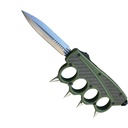
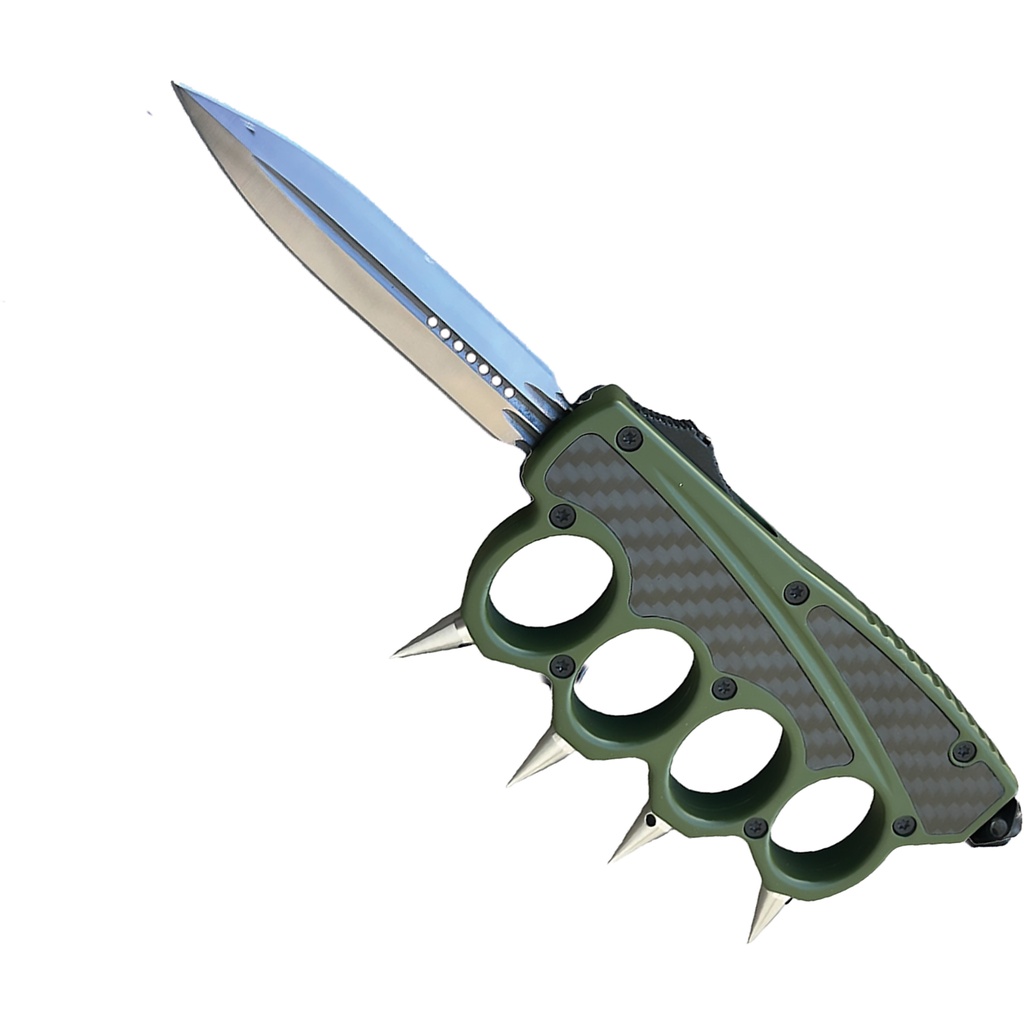
Frontline Knuckle Guard OTF Dagger Knife - Green Carbon
3 sold in last 24 hours
This out-the-front knife is built for Texans who like their hardware loud and honest. A double-action OTF mechanism snaps a polished dagger blade straight out of a green knuckle-guard handle with carbon-fiber inlays. Four rings, spikes, and a glass-breaker pommel give it serious close-quarters attitude, while the pocket clip and nylon case keep it riding ready. It’s not just another automatic or switchblade lookalike—it’s the knuckle-guard OTF that stands out in a serious collection.
| Closed Length (inches) | 5.25 |
| Blade Color | Silver |
| Blade Finish | Polished |
| Blade Style | Dagger |
| Blade Edge | Plain |
| Handle Material | Zinc Alloy |
| Theme | Carbon Fiber |
| Sheath/Holster | Nylon Case |
Frontline Knuckle Guard OTF Dagger Knife - What It Really Is
This piece is a true out-the-front knife, not a side-opening automatic and not a marketing man’s catch-all “switchblade.” When you thumb the side slide, the dagger blade drives straight out the front of the handle and retracts the same way. That double-action OTF mechanism is the heart of this knife, wrapped in a knuckle-guard frame that looks like it walked out of a close-quarters training manual.
The green zinc-alloy handle carries four finger rings, forward-facing spikes, and carbon-fiber patterned inlays on both sides. The blade is a polished, double-edged dagger profile with a central fuller and lightening holes near the base. It’s a combat-styled automatic OTF knife built for Texans who already know the difference between an OTF knife, a side-opening automatic knife, and the broad “switchblade” label the law uses.
How This Out-the-Front Knife Mechanism Works
Mechanically, this is a double-action OTF knife. That means the same thumb slide on the side both fires and retracts the blade—no manual tug, no separate release. Press forward on the slide and the internal spring system snaps the dagger blade out the front. Pull the slide back and the spring system draws it safely back into the handle.
A side-opening automatic knife or traditional switchblade swings a blade out from the side on a pivot. This one runs the blade in a straight line down a track. That difference matters to collectors: the internal tolerances, spring timing, and track alignment are what separate a good OTF knife from a drawer queen. Here, the textured slide gives you tactile purchase, the blade locks out with a decisive click, and the retraction is clean and controlled.
Double-Action OTF Details for Collectors
On a double-action automatic like this, you’re not just buying an OTF that looks wild in the case—you’re buying a mechanism that has to run clean both ways. The dagger blade rides in a machined channel inside the zinc-alloy frame. The slide interfaces with internal linkages and springs that do the work of both launch and recovery. When tuned right, you get reliable deployment without blade rattle, and that’s what you want in an OTF knife you plan to actually cycle instead of just stare at.
Blade and Build: Why This Dagger Profile Works
The polished dagger blade is about 3.5 inches, with an overall length of 8.75 inches open and 5.25 inches closed. That puts it squarely in full-size OTF territory, not a novelty mini. The plain edges suit practical cutting if you decide to put it to work, while the central fuller and drilled holes help balance the blade and keep weight reasonable for an otherwise stout knuckle-guard design.
Knuckle-Guard Design: More Than Just Aggressive Looks
The first thing that jumps out is the handle: four finger holes, forward spikes, and a glass-breaker style pommel. This is a knuckle-guard OTF knife built with close-quarters styling in mind. The green zinc-alloy handle gives it that field-ready, tactical look, while the carbon-fiber style inlays add texture and a modern collector’s touch.
In hand, those four rings lock your grip into place. The spikes at the front of the knuckle guard add visual bite and potential impact utility, while the pointed pommel and lanyard area finish off the profile. It’s the kind of automatic OTF that dominates a display tray—folks spot it before you say a word. That presence is exactly what many Texas collectors want from a knuckle-themed switchblade-style piece, even when they know it’s technically an OTF knife.
Texas Carry, Law, and Real-World Riding
Texas has loosened up over the years on automatic knives, OTF knives, and what the statutes call switchblades. Today, adults in most everyday situations can legally own and carry an automatic or OTF knife like this, but you still need to mind restricted locations and any local rules that may apply. This is not a legal brief—always check current Texas law and your local ordinances before you clip something this bold to your pocket.
Practically speaking, at 5.25 inches closed with a pocket clip and nylon zipper case, this OTF knife will ride in a truck console, range bag, or gear pack like it belongs there. The knuckle-guard shape and spikes make it less discreet than a slim EDC automatic knife, so it’s better suited as a statement piece, a range-day companion, or part of a collection kept on the right side of Texas law.
Texas Context: Automatic, OTF, and “Location-Restricted” Reality
Texas law tends to use broader terms like “location-restricted” knives and switchblade-style definitions rather than splitting hairs over OTF vs side-opening automatic mechanisms. Collectors, on the other hand, care a lot about those distinctions. This piece is specifically a double-action OTF knife with a knuckle-guard handle. Whether you carry it or keep it as a display piece, make sure you understand where Texas draws the line on blade length, knuckle-duster designs, and restricted places like schools and certain public venues.
OTF Knife vs Automatic vs Switchblade: Where This One Fits
Collectors use tighter language than the law. Here’s where this knife lands:
- OTF knife: The blade travels straight out the front of the handle on a track. That’s this knife.
- Automatic knife: Any knife that opens under spring power when you hit a button, slide, or lever. This OTF is also an automatic.
- Switchblade: The broad, old-school term most folks—and many statutes—use for automatic knives in general, including OTF knives and side-openers.
So this green knuckle-guard piece is an automatic OTF knife that many will casually call a switchblade, but mechanically it earns the more precise OTF label. For a Texas collector who cares about mechanism accuracy, that clarity is part of the appeal.
What Texas Buyers Ask About OTF Knives Like This
Is an OTF knife like this the same as a regular automatic or switchblade?
Mechanically, no. An OTF knife drives its blade straight out the front on a track using an internal spring system and a slide or switch. A regular automatic knife—what most folks grew up calling a switchblade—opens out the side on a pivot like a folder. Legally, Texas tends to group automatic knives, OTF knives, and traditional switchblades together, but collectors draw a firm line. This green knuckle-guard model is specifically a double-action OTF automatic, which puts it in a narrower, more specialized category.
Are OTF knives and knuckle-guard designs like this legal to own in Texas?
Texas has come a long way from its stricter days on automatic knives and switchblades. For most adults, owning an OTF knife or automatic knife is legal, and carry is broadly allowed outside certain restricted locations. Knuckle-guard or knuckle-duster style designs, blade length, and where you take the knife can still matter under current Texas law. Treat this as general guidance, not legal advice: before you carry a knuckle-guard OTF knife, review the latest Texas statutes and any local rules, and when in doubt, keep a piece like this as a collection or display knife rather than a daily pocket ride.
Is this more of a working knife or a collector’s piece?
It will cut, no question—but the real value here is collector character. The four-ring knuckle guard, carbon-fiber inlays, polished dagger blade, and double-action OTF mechanism make it a standout automatic in any Texas drawer. This isn’t your quiet ranch fence-fixing tool; it’s the knife you pull out when you want to show the difference between a basic switchblade and a specialized OTF with knuckle-guard styling. Most serious buyers in Texas will treat it as a statement piece, conversation starter, and part of a themed tactical or close-quarters collection.
Why This OTF Knife Earns a Place in a Texas Collection
Texas collectors don’t need every knife to be subtle. Some pieces earn their keep by being mechanically honest and visually unapologetic. This Frontline Knuckle Guard OTF Dagger Knife checks both boxes: true double-action OTF mechanism, clear automatic pedigree, and a knuckle-guard body that doesn’t pretend to be anything else.
It sits at the crossroads of three worlds—OTF knife, automatic knife, and switchblade culture—while wearing a distinctly Texas-friendly tactical look in green with carbon accents. If you’re the kind of buyer who can explain, in one calm sentence, why an OTF isn’t just another switchblade, this is the kind of knife that belongs in your case. It’s built for the Texan who knows their mechanisms, respects the law, and isn’t shy about a knife that turns heads before the blade ever clears the handle.