
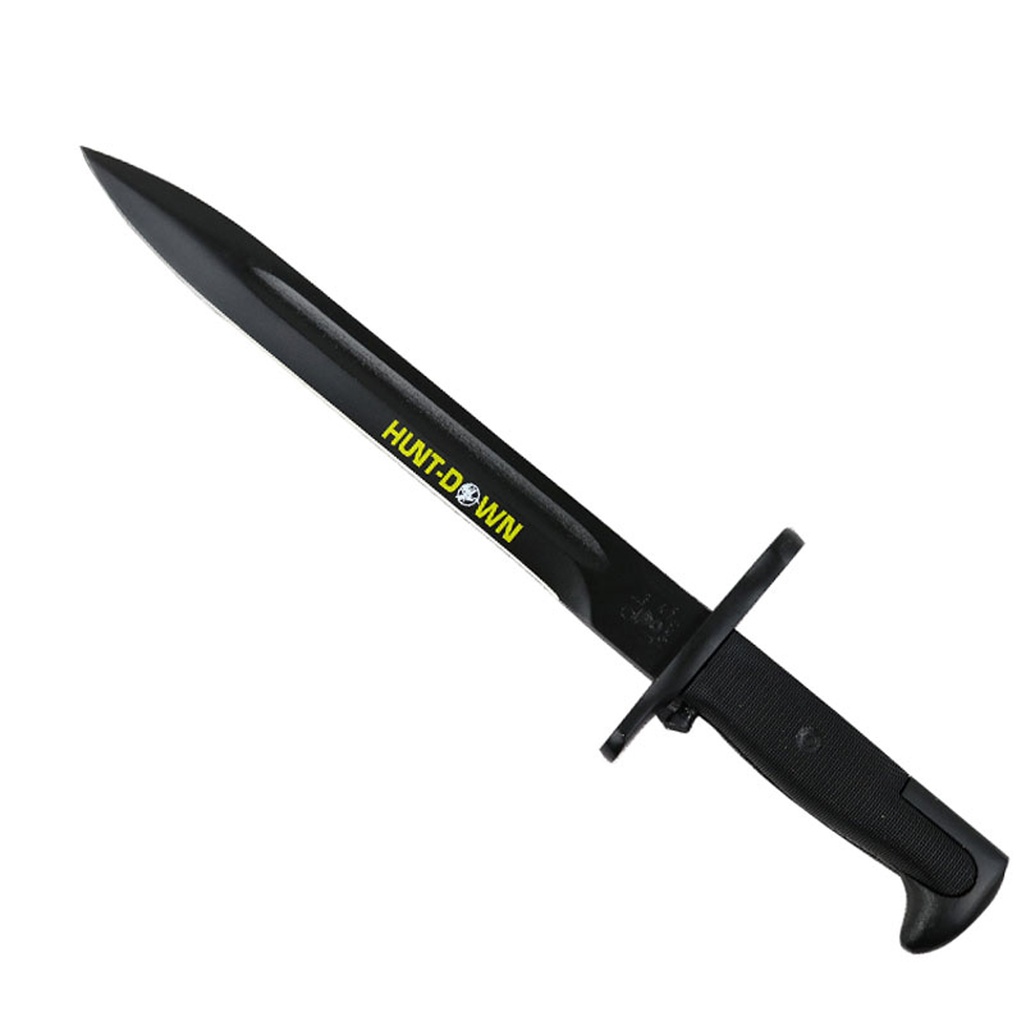


Hunt Down Garand Tribute Bayonet Knife - Black Steel
3 sold in last 24 hours
This WWII 1943 M1 Garand replica bayonet knife delivers a full 14 inches of black steel history with a modern tactical edge. The fixed spear-point blade locks into its hard plastic sheath with a push-button release, echoing the original rifle-mount design. In Texas, it’s a display piece, training tool, or ranch truck blade that stands apart from any automatic knife, OTF knife, or switchblade. It’s for the collector who knows why a Garand bayonet silhouette still matters.
| Blade Length (inches) | 9.5 |
| Overall Length (inches) | 14 |
| Blade Color | Black |
| Blade Finish | Matte |
| Blade Style | Spear Point |
| Blade Edge | Plain |
| Blade Material | Steel |
| Handle Finish | Textured |
| Handle Material | Plastic |
| Theme | Military |
| Handle Length (inches) | 4.5 |
| Pommel/Butt Cap | Integrated pommel |
| Carry Method | Belt carry |
| Sheath/Holster | Hard plastic sheath |
WWII 1943 M1 Garand Replica Bayonet Knife: What It Really Is
This WWII 1943 M1 Garand replica bayonet knife is a fixed blade bayonet, not an automatic knife, not an OTF knife, and not a switchblade. The blade doesn’t spring, slide, or flip out of a handle. It’s already out, already full-length, already ready. The mechanism story here is about how it locks to a sheath or rifle, not how it deploys from the handle.
For a Texas buyer sorting through automatic knives, OTF knives, and side-opening switchblades, this bayonet sits in a different lane: historical combat pattern, fixed blade, full-size, with hardware built to ride on a rifle or on your belt.
Fixed Blade Bayonet vs Automatic Knife, OTF Knife, and Switchblade
A true Garand bayonet like this one tells its story in the hardware. You get the long 9.5-inch spear-point blade, the central fuller, the straight crossguard with barrel ring, and the curved pommel designed to mount to an M1-style rifle. There’s a push-button in the handle, but that button isn’t there to fire a blade like a switchblade or automatic knife. It’s there to release the bayonet from the sheath or rifle lug.
An automatic knife uses a spring to swing a folding blade out from the side of the handle. An OTF knife uses an internal track so the blade slides straight out the front. A switchblade is a specific kind of automatic knife with a button or switch in the handle that kicks a folding blade open. This bayonet isn’t any of those. It is closer to a fighting knife or combat fixed blade, just built with a rifle in mind.
Mechanism: Push-Button Lock, Not Spring Deployment
The push-button on this replica WWII M1 Garand bayonet controls a lock that holds the knife in its hard plastic sheath and interfaces with rifle hardware. Press to release; let go and the bayonet seats back in and stays put. Nothing automatic, nothing out-the-front, nothing switchblade about it. That clarity matters to a Texas collector who knows mechanisms make or break a pattern’s value.
Full-Size Combat Profile and Build
At 14 inches overall with a 9.5-inch black-coated spear-point blade, this bayonet knife is full-size and unapologetic. The matte finish cuts glare, the fuller lightens the blade without making it flimsy, and the textured plastic handle gives you a sure grip. The integrated pommel and guard hardware keep the silhouette faithful to the WWII M1 Garand bayonet form, even with the modern HUNT DOWN skull logo stamped loud in yellow on the blade.
Texas Use: How a Replica Bayonet Fits Real-World Carry
In Texas, a piece like this usually has three lives: display, training, and hard-use utility around land or lease. It rides on a belt in its hard plastic sheath, where that push-button release acts like insurance against it rattling loose in a truck, on an ATV, or walking fence lines. You’re not flicking it open like an automatic knife or driving it out like an OTF knife; you simply press, draw, and you’re holding a full-length fixed blade made to work.
For a Texan with a line of folders, automatics, and the occasional switchblade in the drawer, this bayonet knife answers a different question: What do you reach for when you want reach, leverage, and that old-school military profile that’s built to stab, pry, and clear brush if it has to?
Texas Law and the WWII M1 Garand Bayonet Pattern
Texas knife law has loosened over the years, and that’s good news for collectors who like bigger blades. Under current Texas law, this bayonet is treated as a large fixed blade, not as an automatic knife, OTF knife, or switchblade. There’s no spring-fired deployment to trigger the old switchblade concerns. Instead, the conversation is about length, where you carry it, and how you use it.
Because the blade is long and clearly built on a combat pattern, most serious Texas buyers treat it the way they treat a large Bowie or dedicated fighting knife: great for home, land, display, and training, with a little extra thought before carrying it into town. The law draws bigger lines around location and intent now, not just mechanism, but knowing this bayonet is a fixed blade replica — not a tactical automatic knife or OTF knife — keeps the legal picture cleaner.
Texas Collector Culture and Military Replicas
Texas has no shortage of veterans, reenactors, and military history hounds, and that’s where this M1 Garand bayonet replica really finds its home. It pairs up with a Garand in the safe for display, rides on a reenactment rig, or lives on a wall rack alongside other fixed blade combat patterns. A collector who already owns a modern automatic knife and a slick OTF knife will often reach for a bayonet like this when they want something with story, not just mechanism cleverness.
Collector Value: Why This Bayonet Knife Earns a Place
What separates this WWII 1943 M1 Garand replica bayonet from another generic fixed blade knife is the pattern. The silhouette is instantly recognizable: long spear point, deep fuller, barrel ring, hooked pommel. The black finish and aggressive HUNT DOWN skull logo pull it out of pure museum territory and into modern tactical display. That mix — historical blueprint plus current styling — is exactly what a Texas collector can use to bridge a wall between vintage and modern pieces.
It doesn’t compete with your best automatic knife or your favorite OTF knife. It complements them. Where those are about one-hand deployment and compact carry, this bayonet is about length, leverage, and the feel of steel that was originally meant to live on the end of a rifle. In a serious collection, that contrast is part of the story.
Details That Matter to a Texas Buyer
- 14-inch overall length with 9.5-inch black spear-point blade
- Textured synthetic handle with integrated pommel and guard
- Hard plastic sheath with push-button release lock
- WWII M1 Garand bayonet replica profile with modern tactical branding
- Built for display, training, and tough ranch or lease work
What Texas Buyers Ask About This Bayonet Knife
Is this bayonet an automatic knife, an OTF knife, or a switchblade?
No. This WWII 1943 M1 Garand replica is a fixed blade bayonet knife. The blade is permanently fixed in the open position; it does not fold, fire, or slide out of the handle. The push-button you see is for locking and releasing the bayonet from its hard plastic sheath or compatible rifle mount, not for opening it. If you’re shopping automatic knives, OTF knives, or switchblades, this belongs in a separate "fixed blade combat" lane in your collection.
Is a WWII-style bayonet knife like this legal to own and carry in Texas?
Under current Texas law, owning a bayonet-style fixed blade like this is legal. The law no longer singles out switchblades or automatic knives the way it used to, and an OTF knife or automatic can now be carried more freely. With a long fixed blade bayonet, the questions are more about where you carry it and how it’s used than the mechanism itself. Most Texas collectors keep a piece this size for home, land, range, or reenactment use, not for daily downtown carry, and that’s a good common-sense approach.
Why would a collector add this bayonet if they already own automatics and OTFs?
Because this bayonet fills a different slot. Your automatic knife is about fast one-hand opening. Your OTF knife is about compact, front-deploy precision. Your switchblade, if you run one, is classic side-opening speed. This M1 Garand bayonet replica is about history and reach. It gives you the WWII combat profile in a modern blacked-out finish with that bold HUNT DOWN logo, plus the authentic guard and pommel hardware. For a Texas collector, it rounds out the story: from historical fixed blade to modern automatic knife and OTF knife technology, all under one roof.
Closing: A Texas Knife for Folks Who Know the Difference
This WWII 1943 M1 Garand replica bayonet knife belongs with Texans who can tell an automatic knife from an OTF knife, and both from a true fixed blade. It’s a long, black, full-size bayonet with a working push-button lock, a hard plastic sheath, and a silhouette that still looks right a lifetime after the war that made it famous. If you’re the kind of buyer who wants a rack that shows the whole story — from switchblade mechanisms to out-the-front designs to the steel that rode on rifles — this bayonet has earned its place.