Ranger Grip Full-Tang Tactical Fixed Blade Knife - Green Rubber
3 sold in last 24 hours
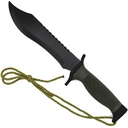
This tactical fixed blade knife earns its place on a Texas belt. The full-tang build, black clip point blade, and partial serrations handle cutting, piercing, and rope work without drama. A guard and sawback-style spine give you control, while the green rubber grip and lanyard tail lock the knife into your hand in rain, sweat, or gloves. It’s not an automatic or OTF knife—it’s the fixed blade you reach for when work gets real.
| Blade Color | Black |
| Blade Finish | Matte |
| Blade Style | Clip Point |
| Blade Edge | Partial-Serrated |
| Handle Finish | Matte |
| Handle Material | Rubber |
| Theme | None |
| Tang Type | Full Tang |
| Pommel/Butt Cap | Lanyard Hole |
Ranger Grip Full-Tang Tactical Fixed Blade Knife - Green Rubber
The Ranger Grip is a true tactical fixed blade knife, built for Texans who know the difference between a belt knife and anything that rides in a pocket. This isn’t an automatic knife, it isn’t an OTF knife, and it sure isn’t a switchblade. It’s a full-tang workhorse that lives on your gear, in your truck, or by the back door—ready every single time without a spring in sight.
What This Tactical Fixed Blade Knife Actually Is
Mechanically, the Ranger Grip is as straightforward as Texas daylight. Full tang from tip to tail, with a matte black clip point blade and partial serrations, it’s designed for cutting, piercing, and quick utility work. Because it’s a fixed blade knife, there’s no deployment step—no button, no thumb stud, no autos, no blades sliding out the front. You draw, you work, you’re done.
Collectors who keep automatic knives, OTF knives, and the occasional switchblade in their rotation appreciate this kind of honesty in a blade. When you reach for a tactical fixed blade, you’re not chasing speed from a spring. You’re betting on strength, leverage, and a grip that doesn’t quit.
Mechanism: Why a Fixed Blade Still Belongs in a Texas Automatic Collection
Fixed Strength vs. Moving Parts
In a drawer full of automatics and OTF knives, a full-tang fixed blade like this one plays a different role. Automatic knives and switchblades give you fast, one-handed deployment from a closed handle. OTF knives run that blade straight out the front with a sliding mechanism. Both rely on springs and internal tracks that demand a little respect and maintenance.
This tactical fixed blade knife skips the complexity. The tang runs all the way through the handle, ending in an exposed butt with a lanyard hole and cord already tied in. That means the force you put into the handle flows directly into the blade—no pivots, no liners, no lock bars. In a fight with brush, rope, or game in the back of the truck, that matters more than any button-fired switchblade trick.
Control, Guard, and Grip
The black clip point profile gives you a fine tip for detail work and penetration, while the partial serrations bite through rope, nylon, or tough packaging. Sawback-style jimping along the spine gives your thumb a home when you choke up. A real guard stands between your fingers and the edge, something most folding automatic knives and OTF knives never quite match.
Then there’s the handle: textured green rubber, contoured to lock into your palm with or without gloves. Wet, muddy, or slick with sweat, it stays put. That’s a different kind of security than any safety switch on a switchblade.
Texas Carry Reality: Fixed Blade Knife in a State That Knows Its Steel
Texas law has grown friendlier over the years to all kinds of blades—automatic knives, OTF knives, and even classic switchblade designs. Fixed blade knives like this tactical model sit comfortably in that same legal landscape, with the main concern being blade length and location, not whether it’s an automatic or not.
For many Texas buyers, the Ranger Grip lives on a belt when you’re on private land, in a ranch truck door pocket, or in a go-bag behind the seat. Around camp, a fixed blade knife beats most automatics simply because it’s always ready and easier to clean. No pivot to gum up, no OTF track to clog with dust, sand, or caliche.
And when you do choose to carry an automatic knife or OTF knife in town, this fixed blade stays in the truck or at the lease—doing the dirty work that would chew up a more delicate switchblade mechanism.
Fixed Blade Knife vs. Automatic, OTF, and Switchblade
If you’ve ever shopped online and watched every seller call everything a “switchblade,” you already know why this distinction matters. A switchblade is a type of automatic knife, usually side-opening from a closed handle with a button or similar release. An OTF knife sends the blade straight out the front of the handle, typically also automatic. Both are about fast deployment from a compact frame.
The Ranger Grip is none of that. It’s a tactical fixed blade knife—no moving parts in the mechanism because there is no mechanism. You trade pocketability for outright strength. In a Texas collection, that makes it the dependable cousin to your OTF and automatic knives. When springs fail, when lint and sand jam up sliders, this one is still cutting.
What Texas Buyers Ask About Tactical Fixed Blade Knives
How does a fixed blade compare to an automatic, OTF, or switchblade in real use?
In real Texas use—on ranch work, hunting trips, or just running fence—a fixed blade knife like the Ranger Grip wins on durability. Your automatic knife and any switchblade-style folder give you pocket carry and fast one-handed opening. An OTF knife adds the novelty and precision of a blade firing out the front. But each depends on internal parts staying clean and intact.
This tactical fixed blade draws from a sheath and goes straight to work. No lock to fail, no button to miss, no track to clog. You lose a little convenience, you gain a lot of confidence.
Is this kind of fixed blade legal to own and carry in Texas?
Texas law is generally friendly to knives now, including automatic knives, OTF knives, and classic switchblade designs, especially for ownership at home or on your property. For carry, Texas uses blade length and certain restricted places as the main lines in the sand. As always, check current Texas statutes and any local rules before you strap on a larger fixed blade knife in town or carry it into public buildings, schools, or posted locations.
For most Texas buyers, this tactical fixed blade rides legally and comfortably on the ranch, at the lease, in the truck, or anywhere that doesn’t have special restrictions posted. The advantage here is that it’s a simple fixed blade, not an automatic or switchblade that used to raise more questions.
Where does this tactical fixed blade belong in a serious collection?
If your collection leans heavy on switchblades, OTF knives, and other automatic knife designs, the Ranger Grip fills the fixed-blade slot for real work. It’s the knife you hand to a buddy when you don’t want to baby the edge or the mechanism. Full tang, guard, serrations, and a grippy rubber handle give it a practical, almost inevitable feel in the hand.
It’s not a safe queen and it’s not trying to outshine the flashiest OTF in the drawer. It earns its place by being the knife you actually use. In a Texas collection, that quiet dependability counts for more than another fancy button-fired switchblade you’re afraid to scratch.
Why This Fixed Blade Knife Belongs in a Texas Kit
In a state that understands steel, there’s room for all three: a good automatic knife for pocket carry, a rugged OTF knife for when you want that out-the-front precision, a classic switchblade or two for history—and a tactical fixed blade like this one for when things get rough. The Ranger Grip doesn’t compete with your automatics; it completes them.
Full tang, rubber grip, black clip point with serrations, guard, and lanyard tail—nothing fancy, nothing fragile. Just a fixed blade knife that feels right in a Texas hand and doesn’t need explaining. If you know why that matters, you’re the kind of buyer this knife was made for.