Scalloped Contrast Brass Knuckles - Brass & Brown Leather
9 sold in last 24 hours
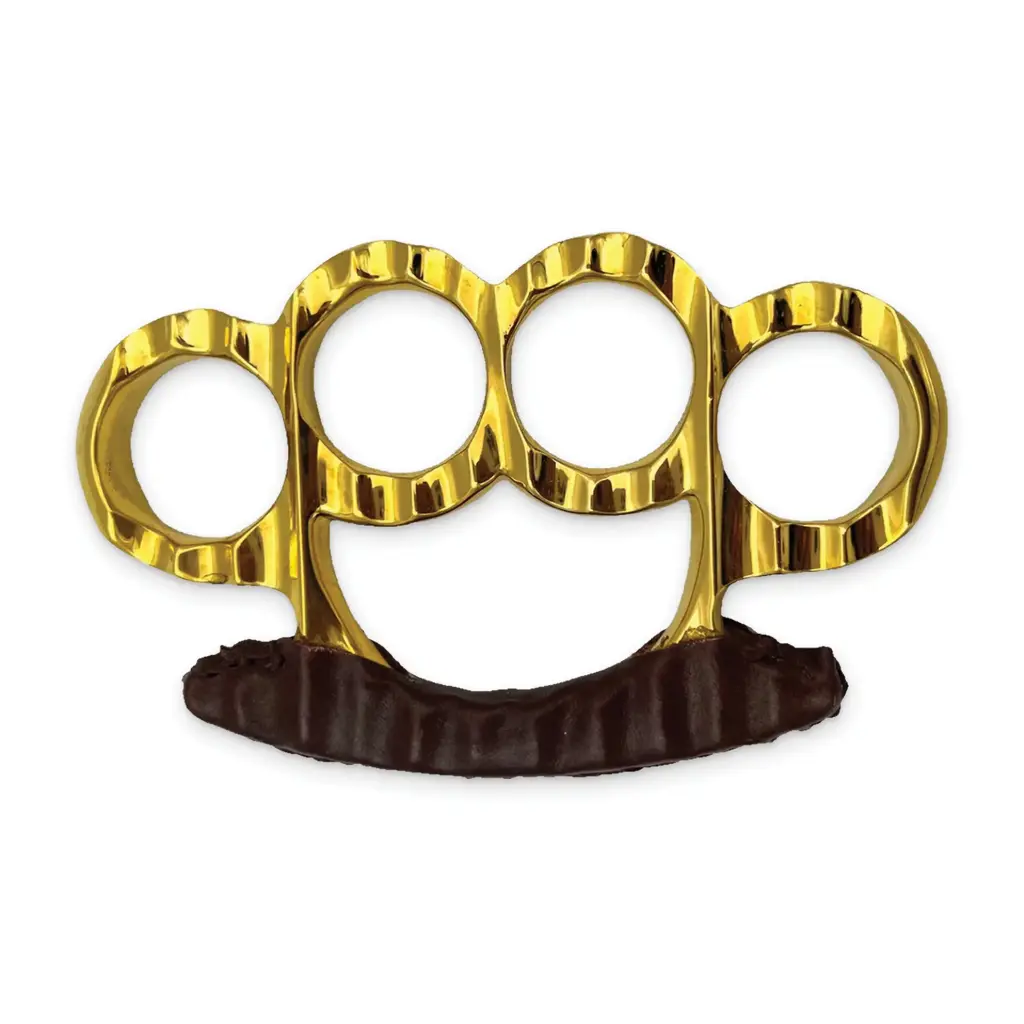
Brass knuckles with a polished frame and brown leather palm bar, this piece belongs to a different collecting category than any automatic knife, OTF knife, or switchblade. Four rounded finger holes form a scalloped upper edge; folded leather gives the curved lower bar a quieter finish. For a Texas collector arranging a cabinet around materials rather than graphics, that contrast does the work. At 4.5 inches long and 15 ounces, it brings measurable substance and an unmistakable outline to a collection built on knowing the differences.
| Weight (oz.) | 15 |
| Theme | None |
| Length (inches) | 4.5 |
| Width (inches) | 2.5 |
| Thickness (inches) | 0.197 |
| Material | Brass, Leather |
| Color | Gold, Brown |
These brass knuckles are a fixed-form brass-and-leather collectible, not a knife with an opening mechanism. Four rounded finger holes establish the familiar outline, while the two middle rings rise above the outer pair to create a scalloped top edge. Below them, dark brown leather covers a curved palm bar. The appeal is straightforward: polished metal catches the light, folded leather breaks it up, and neither material needs a graphic to hold your attention.
Scalloped Contrast Brass Knuckles, Built Around Materials
The brass frame presents a reflective, gold-colored face. Narrow dividers separate neighboring finger holes, keeping the upper row connected without turning it into a broad, uninterrupted plate. Two supports extend downward toward the palm bar, leaving a wide central opening. That open space matters to the appearance: it lets the rounded upper frame and darker lower curve remain distinct, even when you view the piece from across a display cabinet.
Polished frame, folded leather
The leather is more than a change of color. Pronounced folds and wrinkles run across the palm-bar covering, with irregular folded edges near either end. Those details interrupt the smooth visual rhythm of the brass. One surface reflects; the other has visible texture. If you collect by material and construction, that difference gives your eye something worth returning to after the first look.
The exposed brass face has no visible lettering, logos, or decorative graphics. Nothing competes with the scalloped outline. These brass knuckles suit a collector who prefers the materials themselves to carry the design, rather than a symbol or an elaborate surface treatment. The result is restrained without disappearing among brighter pieces.
Brass Knuckles and the Difference Between Knife Types
A collection benefits from accurate names. Brass knuckles are not an automatic knife, an OTF knife, or a switchblade. This piece has no blade and no opening mechanism. Its identifying features are the four-ring frame, central opening, and leather-covered palm bar. Keeping that distinction clear is useful when your interests extend beyond knives into other metal collectibles.
How the opening mechanisms differ
An automatic knife opens its blade through a spring-driven mechanism activated by a control such as a button or slider. Switchblade is a common term for that automatic-opening category; it does not describe a separate blade path. A side-opening automatic swings its blade outward from the handle. An OTF knife sends its blade through the front of the handle, and an automatic OTF belongs within the automatic category.
OTF describes the blade's travel, not a guarantee that every example is automatic. An assisted opener differs again: the user starts the blade moving before the spring assistance takes over. None of those deployment descriptions applies to these brass knuckles. For a Texas collector who keeps several categories together, understanding the distinctions makes the collection more coherent without pretending every object serves the same purpose.
Dimensions That Give the Shape Its Presence
The recorded dimensions are 4.5 inches long, 2.5 inches wide, and 0.197 inches thick, with a weight of 15 ounces. Those numbers give you a useful sense of scale before you choose a place in your collection. The thickness measurement and overall weight describe different things: a relatively thin frame can still bring substantial weight to a compact outline.
At rest, the broad face shows the strongest contrast between the gold-colored metal and brown leather. Viewed at an angle, the open center and narrow connecting supports become more apparent. The raised middle rings also make the top edge easier to distinguish from a straight, level row. This is a shape with several clear visual elements, not simply a flat block of brass.
If you organize a cabinet by size, the measurements help establish its place without relying on photographs alone. If you organize by finish, the polished frame provides the brighter note. Either approach gives these brass knuckles a specific role rather than leaving them as an unrelated addition.
A Texas Collector's Eye for Material Contrast
For a Texas collection that already includes polished bolsters, leather accessories, or undecorated metalwork, this combination offers a natural visual connection. That connection comes from the materials, not an applied regional emblem. There are no Texas graphics on the exposed face, and none are needed to make the piece relevant to a collector here. Your preference for straightforward construction supplies the context.
The strongest reason to choose this version is the leather-covered palm bar. Against an all-metal example, it changes both the color balance and the surface detail. Against a graphic-heavy collectible, it offers a quieter alternative. You get a familiar four-ring silhouette with two plainly different materials doing the visual work.
Separate that collecting decision from any decision about carry. Laws on brass knuckles vary by state and city; check the law where you live and carry. A preference for brass and leather is simple enough. Decisions about taking a regulated product beyond your collection deserve their own attention.
What Texas Buyers Ask About Brass Knuckles
Are these related to an OTF knife, automatic knife, or switchblade?
They are a separate product category. An automatic knife uses a spring-driven opening mechanism, and switchblade commonly refers to that same broad category. OTF identifies a blade that travels out the front of its handle. These brass knuckles have no blade or deployment mechanism; their construction is a fixed brass frame with leather covering the curved palm bar.
Can I carry brass knuckles in Texas?
Laws on brass knuckles vary by state and city. Check the law where you live and carry before making a carry decision.
What makes this version worth choosing for a collection?
Choose it for the contrast rather than ornament. The reflective brass, dark brown leather, scalloped upper edge, and visible folds give it a distinct appearance without lettering or graphics. Its 15-ounce weight and stated dimensions also give you concrete points of comparison when arranging or expanding your collection. If you favor material-led pieces, those are meaningful differences.
A well-chosen Texas collection does not need every piece to look alike. It needs a collector who recognizes what each piece is. These brass knuckles earn their place through polished brass, folded brown leather, and a clear silhouette—separate from your knives, but selected with the same informed eye.