Shadow Line Skull Throwing Knife Set - Black & Blue
11 sold in last 24 hours
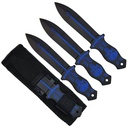
This throwing knife set keeps things simple: full-steel construction, clean balance, and skull graphics you can track in low light. Each 6.5-inch spear point is tuned for both spin and no-spin throws, with cutout handles that keep the weight close to the center line. In Texas or anywhere else you hang a target, the three-piece set rides in a nylon belt sheath, ready for one more round, one more grouping, one more clean release.
| Overall Length (inches) | 6.5 |
| Weight (oz.) | 2 |
| Blade Color | Black |
| Blade Finish | Matte |
| Blade Style | Spear Point |
| Blade Edge | Plain |
| Blade Material | Stainless Steel |
| Handle Material | Stainless Steel |
| Theme | Skull |
| Set Count | 3 |
| Sheath/Holster | Nylon Sheath |
Shadow Line Skull Throwing Knife Set - Black & Blue
The Shadow Line Skull Throwing Knife Set is exactly what it looks like: three slim, full-steel throwing knives built to fly straight and stick clean. No automatic knife springs here, no OTF knife tracks, no switchblade buttons to argue about under Texas law. Just dedicated throwing knives for range time, backyard practice, and the kind of repetition that makes your release honest.
What This Throwing Knife Set Actually Is
Start with the facts. Each knife in this set runs 6.5 inches overall, cut from stainless steel, with a double-edged spear point and a skeletonized handle. At 2 ounces apiece, they live in that sweet middle ground: heavy enough to bite and stay, light enough for session-long throwing without fatigue.
The blue skull art and center stripe aren’t just for looks. Against the matte black steel, that blue gives you visual feedback in flight—how the knife is rotating, where your release timing is off, and whether your spin or no-spin form is consistent. For a Texas collector who already owns an automatic knife or a side-opening switchblade, this set scratches a different itch: pure throwing mechanics, no deployment mechanism in the way.
Mechanics: How These Throwing Knives Work in the Hand
Fixed-Blade Simplicity vs. Automatic Mechanisms
These are fixed-blade throwing knives. That matters. Unlike an automatic knife that relies on a spring and button, or an OTF knife that tracks along a rail inside the handle, this design is one continuous piece of steel. No pivot, no liner, no lock. You grip, you throw, you recover. Simple.
For collectors who already know their way around a switchblade or an OTF knife, this is a different discipline. The only “mechanism” is your grip and your release. The skeletonized handle keeps weight centered, which helps both beginners and experienced throwers dial in spin throws at measured distances as well as close-in no-spin throws. It’s not about how fast the blade deploys from the handle—it’s about how true it flies once it leaves your hand.
Balance, Weight, and Control
At 2 ounces, these throwing knives recover quickly between throws. The cutouts along the handle shift mass toward the center, giving you a predictable rotation for spin techniques. That same balance also keeps them from feeling tip-heavy in a no-spin grip, where you’re relying on a clean, straight release.
This is where a Texas buyer who’s used to EDC folders and automatic knives will feel the difference. There’s no lock bar to clear, no button to find. You focus on stance, distance, and follow-through—nothing else. The feedback from steel on wood tells you more about your form than any fancy mechanism ever will.
Texas Use: Range Time, Backyard Targets, and the Law
Texas has opened up a lot of room for knives, from long blades to automatic knives and legal switchblades, but throwing knives like this still live in their own lane. These are purpose-built for target use—backyard boards, range lanes, and casual competition among folks who understand safe backstops and controlled environments.
Unlike an OTF knife or a side-opening automatic knife you might carry clipped in a pocket, this three-piece set rides in a nylon belt sheath. It’s about transport to and from the throw line, not quick defensive deployment. Texas law has loosened over the years, but common sense never went out of style: know your local rules, keep your throwing to appropriate places, and treat these as sporting tools, not street toys.
Nylon Sheath for Texas Carry Reality
The included nylon sheath keeps all three knives nested together, secured by a retention strap. The belt loop lets you carry them from truck to target without loose steel rattling around in your gear. It’s not a concealed-carry rig the way an automatic knife clip might be; it’s a transport solution for practice sessions, whether you’re in a Houston backyard or out on family land west of San Antonio.
Collector Value for a Texas Knife Drawer
A serious Texas knife collector usually starts with folders—maybe an automatic knife or two, possibly an OTF knife for the mechanical fascination, and a classic switchblade just because the history is too rich to ignore. Throwing knives add another chapter to that story. They don’t compete with those mechanisms; they round out the collection with a skill piece.
The Shadow Line Skull Throwing Knife Set earns its spot for three reasons: it’s visually distinctive, it invites repetition and improvement, and it’s honest about what it is. The black-and-blue skull motif gives it presence on a wall rack or in a display case. The uniform size and balance across all three knives mean you’re training your hand, not fighting mismatched weights. And the full-steel construction keeps the conversation focused on technique, not tuning springs or adjusting pivots.
Display, Training, and the Mechanism Story
Collectors who appreciate the mechanical differences between an OTF knife, a side-opening automatic knife, and a traditional switchblade tend to also appreciate tools that strip all that away. These throwing knives are pure function. That purity makes them a good counterpoint piece in any collection heavy on deployment mechanisms.
On the wall, the blue skull graphics and center stripes line up like a matched set. On the range, they give you a consistent feel throw after throw. In either context, they remind you that not every good knife needs a spring to earn respect.
What Texas Buyers Ask About Throwing Knives
How are throwing knives different from an automatic knife, OTF knife, or switchblade?
A throwing knife like this is a fixed blade made to leave your hand and hit a target. An automatic knife or switchblade is built to open fast from the handle with a button or lever. An OTF knife slides out the front on internal tracks. None of that applies here. With this set, there’s no opening mechanism to debate—just balance, steel, and your technique.
Are throwing knives like this legal to own and use in Texas?
Texas law has become far more knife-friendly, allowing larger blades and automatic knives that used to be restricted, including many switchblade designs. Throwing knives like these are generally legal to own in Texas, but where and how you use them still matters. Treat them as sporting tools: practice on private property with a safe backstop, respect local ordinances, and don’t confuse a range set with an everyday carry automatic knife or OTF knife meant for pocket use.
Is this throwing knife set worth it for a serious Texas collector?
If your collection already covers the usual suspects—automatic knife, OTF knife, classic switchblade—this set gives you something different: a skill-based, purpose-built trio that lives or dies by your technique, not the spring inside the handle. The matching skull artwork, consistent dimensions, and full-steel build make it a clean, themed addition to a Texas collection that values both looks and honest use. It’s not the flashiest mechanism in the drawer, but it will tell you the most about your own hands.
In the end, the Shadow Line Skull Throwing Knife Set is for the Texan who likes to know not just what a knife does, but how it does it. You can appreciate the snap of an automatic knife, the track of an OTF knife, and the heritage of a switchblade—and still step out back with three simple throwing knives and a wooden target. That balance between mechanism curiosity and straight-ahead practice is where real Texas knife collectors live.