Cobra Trench Defense Fixed Knuckle Knife - Matte Black
9 sold in last 24 hours
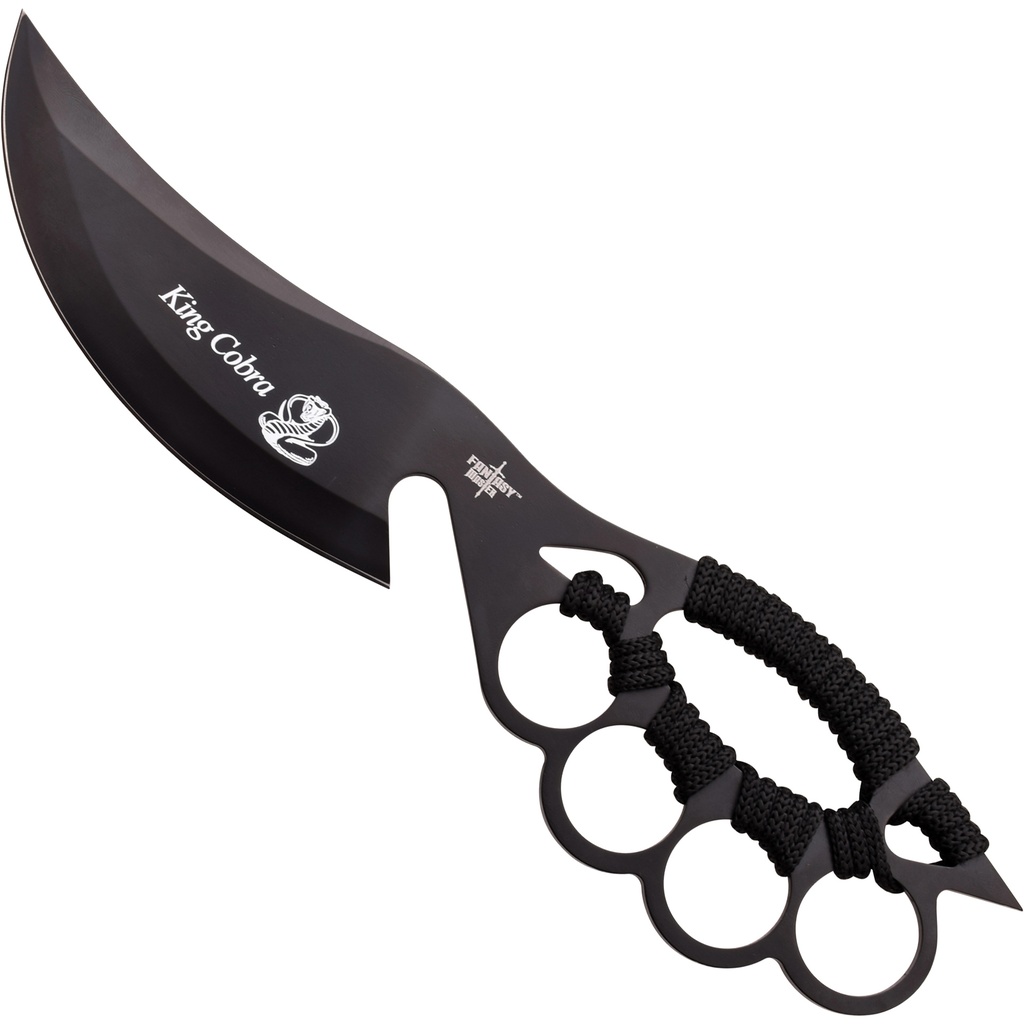
This Trench-Guard Blackout knuckle knife is a full-tang fixed blade built for presence and control. The 5.5-inch trailing-point blade, matte black from guard to tip, rides behind a full-hand knuckle duster with cord-wrapped grip and a pointed skull-crusher pommel. In Texas, it’s a bold display piece more than an everyday carry, but collectors know exactly why it belongs in the case: trench heritage, modern tactical lines, and a silhouette that doesn’t apologize for what it is.
| Blade Length (inches) | 5.5 |
| Overall Length (inches) | 11 |
| Blade Color | Black |
| Blade Finish | Matte |
| Blade Style | Trailing Point |
| Blade Edge | Plain |
| Handle Finish | Matte |
| Handle Material | Steel |
| Theme | Knuckle Duster |
| Handle Length (inches) | 5.5 |
| Tang Type | Full Tang |
| Pommel/Butt Cap | Pointed |
Trench-Style Fixed Knuckle Knife Built for Presence, Not Guesswork
The Trench-Guard Blackout Knuckle Knife is a full-tang fixed blade built around a classic combat idea: protect the hand, hit hard, and keep the edge ready. This isn’t an automatic knife, it isn’t an OTF knife, and it isn’t a switchblade. It’s a solid, one-piece fixed blade with a full-hand knuckle guard and a matte black trailing-point profile that tells you exactly what it’s for the moment you pick it up.
Texas collectors who already know the difference between a spring-driven automatic knife and a trench-style fixed blade will appreciate how honest this piece is. No button, no slider, no assisted opening story—just steel, leverage, and a silhouette that reaches back to World War I trench knives and pulls that heritage into modern tactical form.
Fixed Knuckle Knife Mechanics vs. Automatic, OTF, and Switchblade Designs
Mechanically, the Trench-Guard Blackout is as straightforward as it gets. The 5.5-inch blade and the knuckle duster handle are one continuous full-tang piece of steel, wrapped in cord for grip and finished in a non-reflective matte black. There’s no pivot, no lock, and no deployment mechanism. The blade is always out, always ready, and completely different from any automatic knife, OTF knife, or switchblade you might carry in your pocket.
How This Fixed Blade Differs From Automatics and OTF Knives
An automatic knife uses a spring and a button to swing the blade out from the side. A switchblade is the common name most folks use for that same side-opening automatic. An OTF knife, on the other hand, drives the blade straight out the front of the handle on rails when you slide or push an actuator. All three are folding mechanisms with moving parts and concealed blades.
This trench-style fixed knuckle knife skips all that. There’s no side-opening action, no out-the-front track, and no assisted opener hiding in the handle. What you see is exactly what you have: a full-tang fixed blade with a knuckle-duster style guard and a pointed pommel. For a Texas buyer who understands mechanisms, that’s the appeal—no confusion, no mislabeling, no pretending it’s an automatic or an OTF just to chase a keyword.
Design Details That Matter to Texas Collectors
The blade itself is a trailing-point profile, giving you a long belly for slicing and a fine, upswept tip for control. The matte black finish keeps reflections down and keeps the whole knife visually unified from blade to guard. The full-hand knuckle guard offers four finger holes with enough meat to protect the hand and lend impact if you ever had to punch with it. A cord-wrapped section behind the guard gives your palm traction, and the pointed skull-crusher pommel finishes the profile with a purposeful, aggressive detail.
Texas Law, Knuckle Knives, and Where This Fixed Blade Really Belongs
Texas knife law has opened up a lot over the last decade. Most blades that used to raise eyebrows—automatic knives, OTF knives, and classic switchblade designs—are now generally legal under state law, with some location-based limits. But knuckles and knuckle-duster style weapons have had their own separate history in Texas statutes, and that’s where this fixed knuckle knife brushes up against more complicated territory.
This Trench-Guard Blackout lives in that gray area where a full knuckle guard and a fixed blade share the same steel. While a standard fixed blade is treated as a knife, a true set of metal knuckles may still trigger different rules depending on how a local authority reads the design and current law. A Texas collector who knows their way around automatic knife and OTF knife statutes will already understand: you don’t just toss a trench-style knuckle knife like this into the glove box and forget about it.
Practically speaking, this piece shines as a collection centerpiece, training prop, or display knife at home, in a private office, or behind glass in a shop. It belongs in the same conversation as historical trench knives and modern combat-style fixed blades, not in the everyday waistband rotation next to your EDC switchblade, automatic, or OTF.
Handling, Balance, and Real-World Use for Texas Buyers
In hand, the balance of the Trench-Guard Blackout is exactly where you’d expect for an 11-inch fixed blade: forward enough to give the cut some authority, but not so heavy that the tip wanders. The 5.5-inch trailing-point edge gives you plenty of reach, and the unsharpened spine lets you bear down with your thumb for control cuts.
Knuckle Guard Grip and Control
The full-hand knuckle guard locks your fingers in place. Once your hand is inside those four rings, the knife feels bolted to your arm. That’s a very different handling story from a compact automatic knife or a slim OTF knife meant for quick pocket deployment and light cutting. Here, it’s about retention and power—whether you’re cutting, thrusting, or simply mounting it on a wall where that silhouette can do the talking.
The cord-wrapped section behind the guard adds a bit of cushion and grip, especially if your hands are slick or gloved. Combined with the matte finish, it keeps the knife from feeling like a bare piece of cold steel, even though that’s exactly what it is underneath.
Collector Value: Where This Trench-Style Fixed Blade Fits in a Texas Collection
For a Texas knife collector, this Trench-Guard Blackout isn’t competing with your favorite automatic knife or your best OTF. It’s filling a different slot entirely—the trench and knuckle knife lane that sits between historical reproduction and modern tactical art piece. You buy side-opening automatics and switchblades for the mechanism. You buy OTF knives for that out-the-front thrill and compact carry. You buy a fixed knuckle knife like this for the presence.
The full-tang construction, knuckle-duster guard, and skull-crusher pommel give this knife the kind of silhouette that sells from across the room. The all-black finish makes it photograph well, display well, and anchor a tactical shelf next to your more mechanically complex pieces. It tells a clear story in a collection: this is what happens when a trench knife idea is pushed into modern materials and styling.
Retailers in Texas who cater to collectors know that not every buyer is hunting for another switchblade or automatic knife. Some want that one wild fixed blade that stops traffic in the case. This Trench-Guard Blackout knuckle knife is built for that buyer—the one who already has the OTF knives lined up and wants something that looks like it came straight out of a trench, through a blackout, and onto their wall.
What Texas Buyers Ask About Fixed Knuckle Knives
Is this a switchblade, an automatic knife, or an OTF knife?
No. The Trench-Guard Blackout is a fixed knuckle knife, not a switchblade, not an automatic knife, and not an OTF knife. A switchblade or automatic uses a spring and button to swing the blade from the side; an OTF knife sends the blade out the front of the handle when you slide or push an actuator. This knife has no button, no spring, no sliding track. The blade is permanently fixed in place, full tang, with a knuckle-duster style guard built into the same piece of steel.
Is a fixed knuckle knife like this legal to carry in Texas?
Texas has loosened restrictions on many knives, including automatic knives, OTF knives, and traditional switchblade designs, but knuckles and knuckle-duster style weapons have had their own legal treatment. Because this knife combines a full knuckle guard with a fixed blade, it can fall into a more restricted category depending on current law and how it’s interpreted. Before carrying a trench-style knuckle knife in Texas, a serious buyer should read the most recent Texas statutes and local rules, and when in doubt, treat this as a collection and display piece rather than a daily carry.
Where does this fit in a serious Texas knife collection?
This Trench-Guard Blackout belongs in the same lane as classic trench knives and modern combat-style fixed blades. It’s the kind of knife you hang between your favorite automatic knife and your meanest OTF, as the visual anchor that doesn’t need a deployment story to earn attention. For a Texas collector, it adds knuckle heritage, full-tang fixed blade credibility, and a bold all-black profile that rounds out a tactical-heavy lineup.
In the end, this Trench-Guard Blackout knuckle knife is for the Texas buyer who already knows the difference between a side-opening switchblade, a front-driving OTF knife, and a plain fixed blade—and wants something that leans hard into the trench and knuckle tradition. It’s not shy, it’s not subtle, and it’s not pretending to be anything other than a matte black, full-tang statement piece. If that sounds like it belongs in your case, you’re the kind of collector this knife was made for.