Skullrush Reverse Tanto Assisted Pocket Knife - Red Aluminum
11 sold in last 24 hours
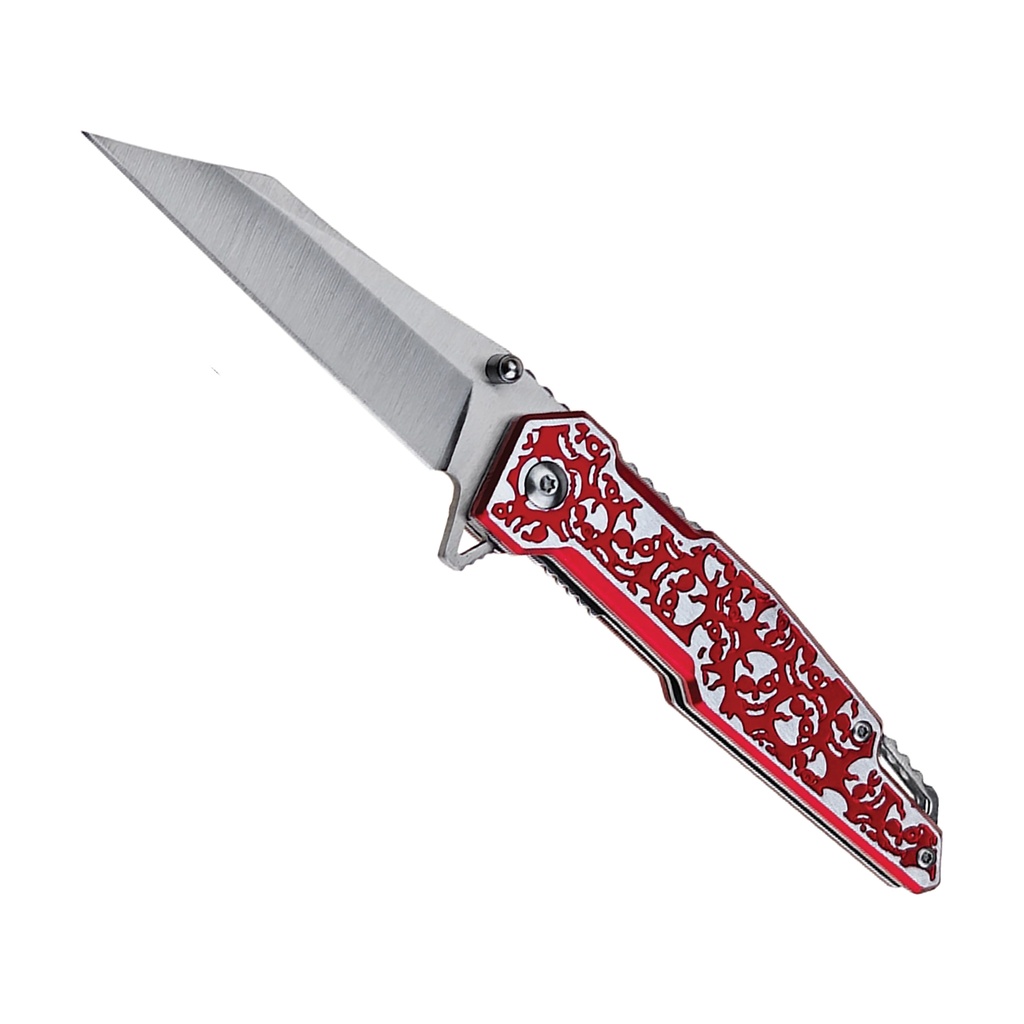
This assisted opening knife doesn’t whisper—it announces itself. The Skullrush Reverse Tanto Assisted Pocket Knife pairs a satin 3Cr13 reverse tanto blade with a skull-engraved red aluminum handle and fast spring-assisted deployment. A liner lock, flipper tab, and pocket clip make it a true everyday carry for Texas buyers who want speed without calling it a switchblade. It rides light, opens clean, and looks like it belongs in the hand of someone who actually uses their knives.
| Blade Length (inches) | 3.69 |
| Overall Length (inches) | 8.22 |
| Closed Length (inches) | 4.53 |
| Blade Color | Silver |
| Blade Finish | Satin |
| Blade Style | Reverse Tanto |
| Blade Edge | Plain |
| Blade Material | 3CR13 Stainless Steel |
| Handle Finish | Glossy |
| Handle Material | Aluminum |
| Theme | Skull |
| Pocket Clip | Yes |
| Deployment Method | Spring-assisted |
| Lock Type | Liner lock |
Skullrush Reverse Tanto Assisted Pocket Knife Explained
The Skullrush Reverse Tanto Assisted Pocket Knife is a spring-assisted folding knife built for everyday carry, not confusion. It’s not an automatic knife, it’s not an OTF knife, and it’s not a classic switchblade. This is a side-opening assisted folder: you start the opening stroke with the flipper or thumb stud, and the internal spring takes it the rest of the way. For Texas buyers who like fast deployment without jumping into full automatic territory, that distinction matters.
Here you’re getting a satin-finished reverse tanto blade in 3Cr13 stainless steel, paired with a skull-engraved red aluminum handle that looks wild in the pocket but works like a practical EDC. It’s the kind of knife a Texas collector throws in rotation when they want some attitude without giving up control.
Primary Mechanism: What an Assisted Opening Knife Really Is
Mechanically, this is an assisted opening knife first and foremost. The blade is manually started, then boosted by a spring once you pass a set point. That’s the key difference between an assisted knife and a true automatic knife or switchblade, where a button or lever releases the blade under full spring power from a closed position.
How the Spring-Assisted Action Works
The Skullrush uses a flipper tab and optional thumb stud. Press the flipper with light pressure, the blade moves a fraction of an inch, then the internal spring kicks in and finishes the opening in one smooth snap. A liner lock secures the blade once it’s open, giving you a familiar, reliable lockup that Texas collectors trust in a working folder.
This is not an OTF knife—the blade doesn’t travel straight out the front of the handle. It swings out from the side on a pivot like any traditional folding knife. And because you have to start that motion by hand, it lives in a different mechanical class than a switchblade, even though the final opening feels just as decisive.
Blade, Steel, and Everyday Texas Use
The reverse tanto blade profile gives the Skullrush a strong, reinforced tip and a long, usable cutting edge. At roughly three and a half inches of 3Cr13 stainless, it’s tuned for everyday utility—opening boxes, cutting straps, quick camp chores—rather than pure showpiece duty. The satin finish cleans up easy and hides light wear better than high-polish blades.
Control in the Hand
Jimping along the spine lets your thumb lock in for push cuts and detail work. That reverse tanto point gives you precision when you need to pierce or score, and the straight portions of the edge handle routine cutting without fuss. For Texas buyers who actually use what they carry, it brings more than just skull art to the table.
Closed, it rides like a standard pocket knife. The tip-down pocket clip keeps it anchored in a jeans pocket, work pants, or a ranch jacket. It’s easy to forget it’s there—until you need it, and that assisted opening does what it was built to do.
Texas Carry Reality: Assisted Knife vs. Automatic Knife vs. Switchblade
Texas law has opened up a lot for knife owners, but it still pays to understand what you’re carrying. This Skullrush is an assisted opening knife, not a button-release automatic knife, not an OTF, and not a traditional side-opening switchblade. You physically move the blade before the spring helps you; that matters when you’re sorting out categories and talking knives with serious Texas collectors.
Texas statutes today focus more on blade length and "location-restricted" knives than on whether it’s an assisted knife or an automatic. Still, collectors in Texas like to keep those lines clean: an OTF knife launches straight out the front; a switchblade or automatic knife jumps from closed to open with a button or similar device; this assisted folder needs that initial nudge from you. Knowing the difference is part of knowing your gear.
Skull Aesthetics, Collector Value, and Display Appeal
What sets this piece apart in a Texas collection isn’t just the mechanism; it’s the skull-engraved red aluminum handle. The glossy red scales, filled with white skull art, give it a gothic, almost tattoo-flash feel that jumps out of a display case or knife drawer. Other assisted knives may be subtle. This one is not. It’s made for buyers who want their EDC to look like it has a story, even before they tell it.
Aluminum keeps the weight down and the feel crisp in the hand. The hardware, pocket clip, and satin blade contrast sharply with the red and white handle, and that reverse tanto profile ties the whole tactical look together. Texas collectors who keep a skull-themed row in their case will see exactly where this one fits.
What Texas Buyers Ask About Assisted Opening Knives
Is an assisted knife the same as an automatic, OTF, or switchblade?
No, and this is where words matter. An assisted opening knife like the Skullrush needs you to start the blade moving with a flipper or thumb stud before the spring takes over. A switchblade or automatic knife uses a button or release to send the blade from fully closed to fully open under spring power. An OTF knife (out-the-front knife) pushes the blade straight out of the handle, usually with a thumb slide. All three are fast, but they’re mechanically different, and a Texas collector will call each one by its right name.
Is it legal to carry an assisted opening knife in Texas?
Under current Texas law, assisted opening knives are generally treated like other folding knives. The bigger legal questions center on blade length and where you carry, not whether it’s assisted or automatic. You should still check the latest Texas statutes and any local rules, but for most adult Texans, an assisted opening pocket knife like this is a normal part of everyday carry, from job sites to back roads.
Why would a collector choose this assisted knife over a switchblade or OTF?
Collectors pick a knife like the Skullrush when they want fast, one-handed opening in a format that feels familiar and pocket-friendly. A side-opening assisted knife sits flatter in a jeans pocket than many OTF knives, and it doesn’t rely on a push-button like a true automatic knife or switchblade. Add in the skull-engraved red aluminum handle and reverse tanto blade, and you’ve got a piece that brings attitude and utility in the same package—easy to carry, loud on the table, and mechanically honest about what it is.
Closing: A Texas Knife for Someone Who Knows the Difference
The Skullrush Reverse Tanto Assisted Pocket Knife is built for the Texan who can tell an automatic knife from an assisted opener at a glance and doesn’t confuse an OTF knife with a side-folder. It earns its place by combining quick, spring-assisted deployment, a tough everyday blade profile, and skull-heavy red aluminum scales that bring some swagger to your EDC line-up.
If you’re building a Texas collection that respects mechanism as much as looks, this is the kind of assisted opening knife that fits right between your switchblade and your OTF—different tool, different story, clearly defined. That’s how serious knife people in Texas like it.