Yellowline Contour Spring Assisted Knife - Black Aluminum
9 sold in last 24 hours
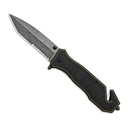
The Yellowline Contour Spring Assisted Knife starts with your manual input, then lets the spring finish opening its 3.5-inch tanto blade. It is an assisted folder, not an automatic knife or switchblade, and its blade pivots sideways rather than traveling forward like an OTF knife. For a Texas day of opening cartons or working through cord, the combination edge and textured aluminum handle make practical sense. Yellow dashed trim gives the dark build its identity—a distinct addition for someone who knows exactly which mechanism belongs in the drawer.
| Blade Length (inches) | 3.5 |
| Overall Length (inches) | 8 |
| Closed Length (inches) | 4.5 |
| Blade Color | Black |
| Blade Finish | Stonewashed |
| Blade Style | American Tanto |
| Blade Edge | Partial-Serrated |
| Blade Material | 8Cr13MoV stainless steel |
| Handle Finish | Textured |
| Handle Material | Aluminum |
| Theme | None |
| Safety | Liner lock |
| Pocket Clip | Yes |
| Deployment Method | Spring-assisted |
| Lock Type | Liner lock |
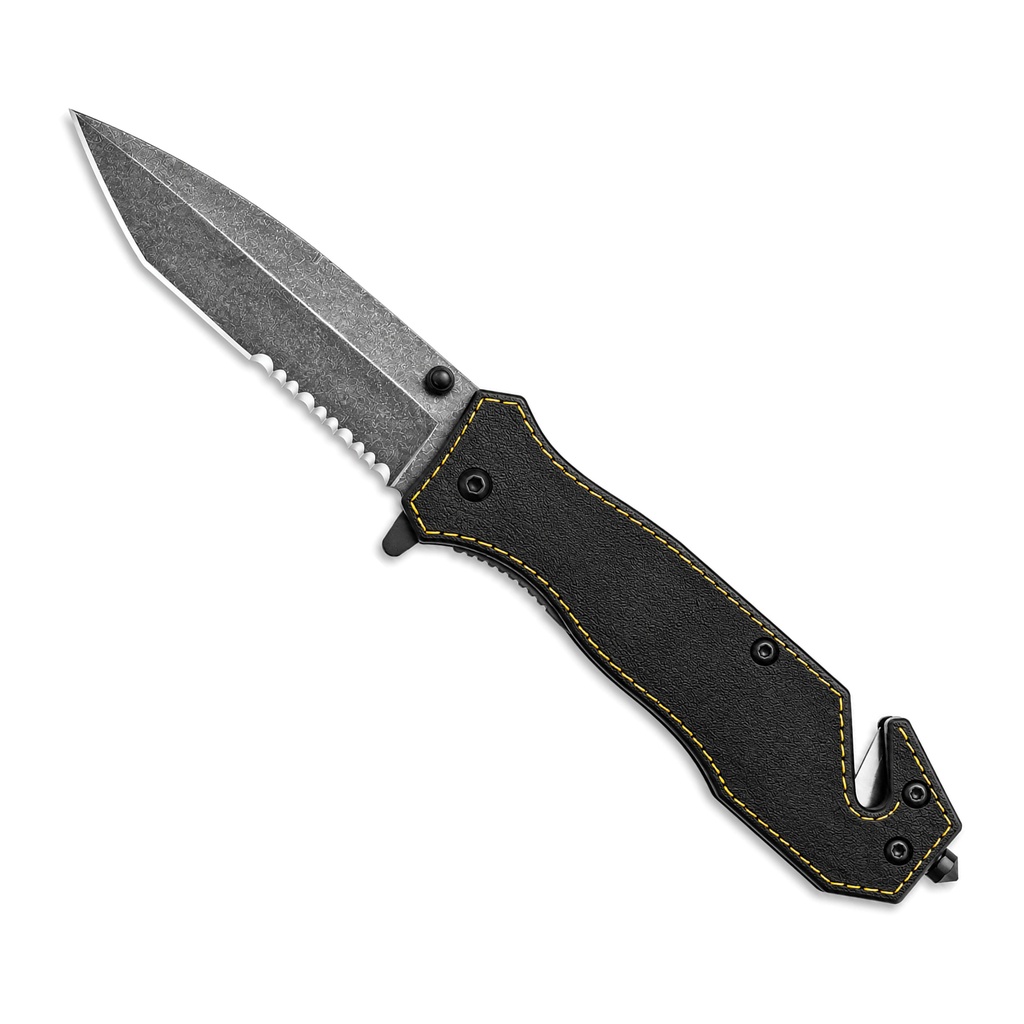
The Yellowline Contour Spring Assisted Knife is a folding knife you start opening manually before the spring helps finish the movement. Its blade swings from the side of the handle; it does not travel out through the front. That puts it in the assisted-opening category, separate from an automatic knife or switchblade. The distinction matters, but so does the knife itself: a black aluminum handle outlined in yellow, a dark stonewashed tanto blade, and a combination edge built around ordinary cutting work.
Yellowline Contour Spring Assisted Knife: The Mechanism Comes First
A knife earns its place through use, and the opening mechanism is where that relationship starts. Yellowline Contour uses spring assistance rather than automatic deployment. You initiate blade movement manually, and the spring then contributes to opening. That sequence gives this folder its proper name and separates it from neighboring categories that too often get lumped together.
Manual initiation, followed by spring assistance
A round black thumb stud sits near the blade pivot, and a flipper tab projects beneath the handle. These are familiar features on an assisted folder. Keep fingers clear of the blade path during opening, and make sure the blade reaches its locked position before cutting. Deliberate handling matters more than making deployment look fast.
A liner lock for the open blade
The liner lock holds the blade open after deployment. Closing requires moving the locking liner clear of the blade before folding it back into the handle. Keep the cutting edge away from your fingers throughout that movement. Spring assistance and blade locking perform different jobs: one helps open the knife, while the other secures it for use.
Assisted Opening, Automatic Knife, and OTF Knife: Different Details
An automatic knife opens through activation of a release mechanism, commonly a button or slider, rather than the user manually beginning blade rotation. Switchblade is a common term for that automatic-opening family. An assisted opener instead requires that initial manual movement of the blade. Yellowline Contour belongs to the latter group.
OTF means out the front. It describes the blade's travel through the front of the handle instead of around a side pivot. Many familiar OTF designs are automatic, so those terms can overlap without meaning exactly the same thing. This knife has a side-pivoting blade and spring-assisted deployment. For a Texas collector sorting a mixed drawer, those two facts tell the mechanism story cleanly.
A Spring Assisted Knife with a Tanto Combo Edge
The 3.5-inch blade uses 8Cr13MoV stainless steel and an American tanto profile. Its angular tip creates a distinct transition between the forward edge and the main cutting section. That shape looks different from a sweeping drop point because it is different: the edge changes direction sharply rather than following one continuous curve.
Partial serrations sit near the handle, leaving a plain section toward the front. The plain edge suits controlled cuts through packaging, while the serrated section gives you another option for fibrous material such as cord. Neither section needs a dramatic explanation. They offer two cutting surfaces on one folding blade, and the useful choice depends on the material in front of you.
The black stonewashed finish adds a mottled surface with lighter markings. Against the yellow-trimmed handle, it keeps the overall appearance dark without making every surface look identical. When sharpening, treat the plain edge and serrations according to their different shapes rather than trying to maintain both with the same stroke.
Texas Daily Carry Starts with Fit, Grip, and Good Judgment
Yellowline Contour measures 4.5 inches closed and 8 inches overall when open. Those measurements give you a better basis for comparison than calling it compact or full-size. Put that closed length beside a folder you already carry, and consider how much handle you prefer when working through a stack of cartons or trimming cord at a workbench.
The aluminum handle has a finely textured black surface, a curved finger recess underneath, and short grip ridges behind the flipper tab. A pocket clip provides a way to keep the folder accessible rather than loose among keys and change. Pocket space is personal; the right fit depends as much on your clothing and routine as on the knife's measurements.
A recessed strap cutter sits near the handle butt, with its cutting edge sheltered inside a hook-shaped opening. It adds a separate place to cut suitable straps without using the main blade. Keep that opening clear of debris and inspect the knife regularly. For Texas buyers, laws on this type of product vary by state and city; check the law where you live and carry.
What Texas Buyers Ask About Spring Assisted Knife
Is this an OTF knife, an automatic knife, or a switchblade?
It is a spring-assisted folding knife. You manually begin opening the blade, then spring assistance completes the movement. It is not an automatic knife or switchblade, and the blade rotates from the side rather than extending through the handle's front. OTF describes that front-opening arrangement; assisted describes how this knife helps you complete deployment.
Can I carry this spring-assisted knife in Texas?
Laws on this type of product vary by state and city. Check the law where you live and carry.
What makes this one worth adding to a collection?
The yellow dashed outline gives it a recognizable identity without covering the handle in a large graphic. That detail works with the textured aluminum, dark stonewashed blade, and angular tanto profile. The combination edge and recessed strap cutter also give you functional differences to compare with a plain-edge folder. It earns consideration as a distinct assisted-opening piece, not as a substitute for another mechanism.
A well-chosen Texas collection can include an OTF, a side-opening automatic, and an assisted folder without confusing their roles. Yellowline Contour brings its own combination: manual initiation, spring assistance, a liner lock, and yellow trim that follows the handle's shape. If those details match how you use and collect knives, this is a piece with a clear place of its own.