Curved Guard Heritage Medieval Arming Sword - Black Leather
14 sold in last 24 hours
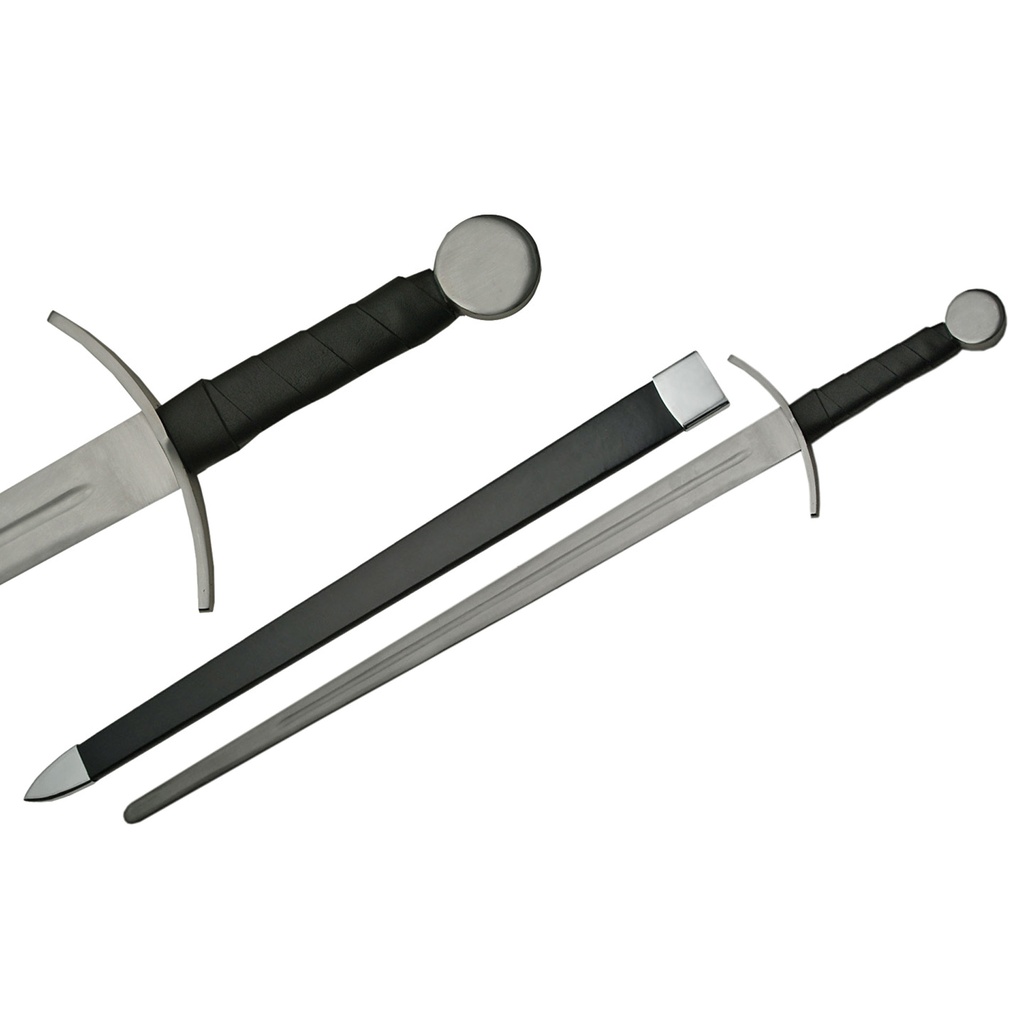
This battle-ready medieval sword delivers a clean, heritage arming profile: a straight 33-inch double-edged blade with central fuller, full tang construction, and a confident curved guard. The black leather-wrapped grip and matching sheath keep the look serious and functional, not flashy. At 40 inches overall, it’s built for reenactment, stage combat, or a commanding wall display. If you like your steel plainspoken and ready to work, this one earns its place in the rack.
What This Battle-Ready Medieval Sword Really Is
The Curved Guard Heritage Medieval Arming Sword - Black Leather is a full tang, battle-ready medieval sword built in the plain, working style collectors respect. You’re looking at a straight 33-inch double-edged blade with a central fuller, a curved steel crossguard, round disc pommel, and a black leather-wrapped grip with a matching leather sheath. No fantasy spikes, no gimmicks—just a clean arming sword profile that could sit comfortably in a historical Texas collection right alongside your automatic knife, OTF knife, or favorite switchblade.
Battle-Ready Medieval Sword Mechanics and Build
Unlike a folding automatic knife or an OTF knife with internal springs and tracks, this is a fixed-blade medieval sword built around one big mechanical truth: full tang strength. The steel runs the length of the handle, anchored under the black leather wrap and locked in by the round disc pommel. That’s what lets a battle-ready sword handle real contact work for reenactment and stage combat when used correctly.
The double-edged blade carries a single central fuller to lighten the steel and help the 40-inch overall length balance under the pommel. Where a switchblade or OTF knife lives and dies by deployment speed, a medieval sword lives by balance and follow-through. This one sits in the hand with a straightforward, arming-sword feel—quick enough for stage work, steady enough for controlled cuts in reenactment practice.
Full Tang Confidence
For Texas buyers who already know their way around automatic knives and OTF knives, think of full tang in the same no-nonsense way you think about a solid, well-pinned handle on a side-opening automatic. No hidden shortcuts. You can feel that in this medieval sword the moment you pick it up—no rattle, no wiggle, no mystery between blade and grip.
Curved Guard, Round Pommel, Straight Intent
The curved crossguard gives your hand a little extra reassurance in thrusts and cuts, while the round disc pommel works as a simple counterweight, not an ornament. That combination is what makes this a true heritage-style medieval arming sword, not a fantasy wall-hanger.
How a Medieval Sword Fits a Texas Collection
Texas knife collectors already juggling an automatic knife or two, a serious OTF knife, and maybe an old-school Italian switchblade know that a collection feels different once you add real-length steel. A battle-ready medieval sword like this one changes the wall, the room, and the collection story.
The straight double-edged blade and black leather sheath read clean from across the room—silver steel and black leather, nothing loud, nothing plastic. In a Den, office, or shop, it pairs well with neatly racked automatics and OTFs, giving you both a historical anchor and a visual line from old-world blades to modern mechanisms.
From Stage to Reenactment
This medieval sword is built for stage utility and reenactment, not just static display. The battle-ready construction and full tang make sense for choreographed combat and controlled drilling. You don’t swing it like a machete and you don’t treat it like a cheap replica. You treat it like you would a good automatic knife in Texas—respect the edge, respect the law, and use it for the work it was built to do.
Texas Context: Swords, Law, and Long Steel
Texas law has relaxed over the years, and that matters whether you’re carrying an automatic knife, slipping an OTF knife into a boot, or hanging a medieval sword on the wall. Under current Texas law (always check the latest statutes), most blades—including switchblades and long swords—are legal to own. The divide is less about type and more about how and where you carry them.
A battle-ready medieval sword like this isn’t a daily carry piece. It’s a display, training, and performance tool. In Texas, that usually means it lives at home, at your training hall, or in the truck on the way to a reenactment or stage event. The same collector eye that checks local rules before pocketing an automatic knife in a school zone should treat a medieval sword with equal attention—especially at public events, festivals, or parades.
Medieval Sword vs. Automatic Knives, OTF Knives, and Switchblades
Knife people in Texas pay attention to mechanisms, and that’s where this medieval sword sits in its own lane. A side-opening automatic knife uses an internal spring to kick the blade out from a folded position. An OTF knife rides a track and launches straight out the front with a thumb slide or button. A switchblade is a legal and cultural term that usually points back to those spring-driven automatics.
This medieval arming sword doesn’t deploy, it’s already there. No springs, no buttons, no tracks—just a fixed, full-length blade riding in a leather sheath. For a collector, that’s the appeal: the mechanism story here isn’t about speed, it’s about structure and history. The full tang, the curved crossguard, the disc pommel, the central fuller—all of it explains how people carried steel long before anyone dreamed up an OTF knife or an automatic switchblade.
Collector Logic: One Rack, Three Eras
A serious Texas collection can tell a story in three lines: the medieval sword line on the wall, the fixed and field blades on the bench, and the automatic knives, OTF knives, and switchblades in the case. This Curved Guard Heritage Medieval Arming Sword settles naturally into that first line. It’s the piece that reminds guests—and you—where all this love of steel started.
What Texas Buyers Ask About Battle-Ready Medieval Swords
Is a medieval sword like this anything like an automatic knife, OTF knife, or switchblade?
Mechanically, no. An automatic knife or switchblade hides its blade inside the handle and uses a spring to snap it open. An OTF knife sends the blade straight out of the front on rails. This medieval sword is a fixed, full-length blade riding in a leather sheath. Where automatics and OTF knives are about fast deployment, a battle-ready medieval sword is about reach, leverage, balance, and durable full tang construction. The connection is collector-level: three very different approaches to putting steel in your hand.
Is a battle-ready medieval sword like this legal to own and display in Texas?
As of recent Texas law changes, most long blades—including swords and switchblades—are legal to own. The real questions are where you carry and how you use them. A medieval sword like this is typically fine to display at home or in a private collection. Public carry can trigger different rules depending on location—courthouses, schools, certain events—just like with an automatic knife or OTF knife. The smart Texas move is to check the current Texas Penal Code and any local ordinances before hauling long steel into public spaces.
What makes this particular medieval sword worth a spot in a serious Texas collection?
The unapologetically plain build. You get a straight 33-inch double-edged blade with a central fuller, full tang construction, a curved steel guard, disc pommel, and black leather wrap that matches the sheath. No costume-shop brass, no plastic details. For a collector who already knows their way around OTF knives, automatic knives, and classic switchblades, this medieval sword feels the same way a well-made user automatic does: simple, functional, and honest. It presents as a working arming sword first and a display piece second, and that’s exactly what many Texas collectors are looking for.
Closing: A Texas Collector’s Kind of Steel
The Curved Guard Heritage Medieval Arming Sword - Black Leather is for the Texan who can tell the difference between an automatic knife, an OTF knife, and a switchblade without thinking—and still wants a length of honest medieval steel on the wall. It doesn’t compete with your pocket blades; it explains them. Full tang, battle-ready construction, straightforward arming sword lines, and a black leather sheath that looks right at home beside tooled belts and old scabbards. If you like your stories told in steel, this medieval sword speaks in a voice as plain and direct as Texas itself.