Denim Seam Flipper Spring Assisted Knife - Faded Blue
3 sold in last 24 hours
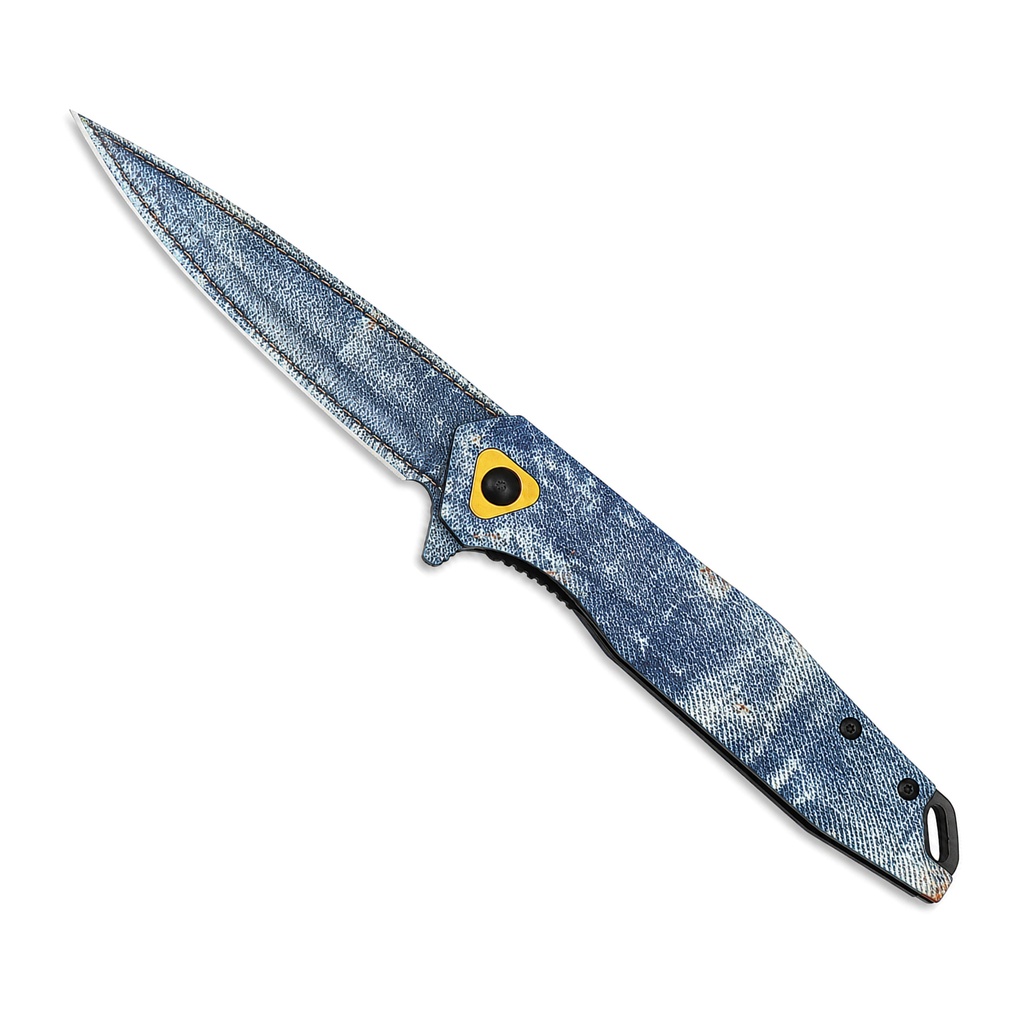
This Spring Assisted Knife starts with your push on the flipper, then lets spring assistance finish the opening. Denim graphics cover its stainless steel blade and handle, with printed stitching and a gold-tone pivot accent setting the workwear tone. Beside your jeans and keys in a Texas daily rotation, the pocket clip and lanyard opening serve practical purposes. It is an assisted folder, not an automatic knife or switchblade, and its blade swings outward rather than traveling like an OTF knife. Familiar styling, correctly understood mechanics.
| Blade Length (inches) | 3.5 |
| Overall Length (inches) | 8.25 |
| Closed Length (inches) | 4.75 |
| Blade Color | Blue |
| Blade Finish | Printed |
| Blade Style | Normal Straight |
| Blade Edge | Plain |
| Blade Material | Stainless steel |
| Handle Finish | 3D printed |
| Handle Material | Stainless steel |
| Theme | Denim |
| Pocket Clip | Yes |
| Deployment Method | Spring-assisted |
| Lock Type | Liner lock |
The Denim Seam Flipper Spring Assisted Knife is a folding knife with a manual start: you move the blade with the flipper, and spring assistance helps complete the opening. Its blade swings out from the handle rather than traveling through the front. That distinction matters before the denim pattern ever enters the conversation. Once it does, there is plenty to notice: faded blue-and-white graphics across blade and handle, orange-brown printed stitching, and a warm gold-tone accent around the black pivot screw. It brings a familiar workwear look to an everyday pocket tool without pretending to be made of cloth.
Spring Assisted Knife Mechanics: A Manual Start
The flipper tab sits below the pivot when the knife is open. From the closed position, it gives your finger a place to begin rotating the blade. The spring assists that movement after you initiate it. This is the mechanical distinction that separates an assisted opener from an automatic knife activated by a release control.
Flipper deployment and liner-lock engagement
Once open, the liner lock holds the blade in its working position. A ridged metal liner is accessible inside the handle near the finger recess. Closing requires moving that liner clear of the blade before folding it back into the handle. Keep your fingers outside the blade's closing path, and take time to become familiar with the action before putting it to work.
The flipper also forms a small finger guard when open. Behind it, the handle underside curves inward into a finger recess. Those are useful details to notice alongside the mechanism: the opening control, lock, and handle shape each have a separate job.
Denim Details in Stainless Steel
The workwear theme comes from printed graphics, not a fabric covering. Both blade and handle are stainless steel. Across those surfaces, the faded blue-and-white weave creates the appearance of worn denim, while the orange-brown lines around the blade imitate stitched seams. The narrow silver cutting bevel remains a contrasting line beneath the printed blade face.
A coordinated pattern, not just a colored handle
Many themed folders keep their decoration on the handle. Here, the blade carries the idea forward, making the open knife a more complete expression of the design. The rounded triangular gold-tone pivot accent interrupts the blue just enough to become a focal point. Black screws and the dark rear extension provide quieter contrast.
The blade measures 3.5 inches and has a plain cutting edge. Its long, nearly straight spine leads toward a pointed tip as the cutting edge curves upward. For everyday cutting such as opening packaging or trimming cord, the uninterrupted edge offers a straightforward working profile. The printed treatment supplies the visual character; the exposed bevel does the cutting.
For a collector, that division is worth appreciating. The knife has a clear visual identity without needing an elaborate blade shape to tell its story.
Spring Assisted Knife vs. Automatic and OTF Mechanisms
An automatic knife opens through a release mechanism, commonly a button or slider, rather than requiring you to rotate the blade manually to begin assisted deployment. A switchblade generally refers to that automatic-opening family. Neither term accurately describes this folder's manual-start action.
An OTF knife is defined by its blade path: out the front of the handle. Many OTF designs are automatic, but the direction of travel and the method of activation are separate characteristics. A side-opening automatic swings around a pivot, while an automatic OTF moves its blade along the handle's length. This denim folder also pivots sideways, but spring assistance follows your manual start.
That is why appearance alone cannot settle the category. A flipper tab, patterned handle, or pocket clip does not turn a knife into a switchblade. The opening sequence tells you more than the styling does.
If your collection already includes an OTF knife, this piece adds a different action as well as a different look. If you favor assisted folders, its appeal is more specific: familiar flipper operation paired with a coordinated denim treatment. There is no need to blur the categories to appreciate either one.
Texas Carry Starts With Practical Details
At 4.75 inches closed and 8.25 inches overall, this is a folder with measurable pocket presence. Compare that closed length with a knife you already carry, especially if your jeans have shallow front pockets. Dimensions tell you more about daily fit than a photograph can.
The pocket clip offers an attachment point at a pocket edge. An elongated lanyard opening in the black handle extension gives you another way to personalize the setup. Neither feature changes the mechanism, but both affect how the knife fits into your routine.
For a Texas buyer building a practical rotation, the denim finish makes sense beside ordinary workwear. It does not need a staged ranch scene or a tactical label. Jeans, keys, and a clearly understood folding knife are enough context.
Laws on this type of product vary by state and city. Check the law where you live and carry.
A Spring Assisted Knife should earn its pocket time through fit and function as well as appearance. Here, the plain edge, flipper, liner lock, and matching printed surfaces give you concrete details to weigh against the folders you already own.
What Texas Buyers Ask About Spring Assisted Knife
Is this an OTF, an automatic, or a switchblade?
None of those describes this knife's action. It is an assisted-opening folder: you start blade rotation manually using the flipper, and a spring assists the opening. An OTF blade travels through the handle's front; an automatic or switchblade uses a release mechanism to initiate automatic opening.
What should I check before carrying this knife in Texas?
Laws on this type of product vary by state and city. Check the law where you live and carry.
What makes this worth adding to an assisted-folder collection?
The coordinated denim graphics distinguish it from a plain-finished folder, especially because the pattern continues onto the blade. Stainless steel construction, a 3.5-inch plain edge, a liner lock, and flipper deployment give the design a practical foundation. Choose it for that combination rather than expecting the action of another knife category.
A considered Texas collection has room for different mechanisms and a little individuality. This one earns its place through a recognizable denim pattern and an assisted action you can name correctly. Know what opens it, know what holds it open, and let the workwear details speak for themselves.