Current Damascus-Style Spring Assisted Knife - Blue and Gold
11 sold in last 24 hours
The Current Spring Assisted Knife pairs manual-start, spring-assisted opening with blue-and-gold marbling and a patterned 440C stainless steel blade. It folds from 8.25 inches overall to 4.75 inches closed, with a pocket clip for your everyday rotation. At a Texas collector's workbench, its appeal is straightforward: a plain-edge drop point, a liner lock, and decoration that carries across blade and handle. This is an assisted folder, not an automatic knife or OTF knife—the right distinction for someone who chooses a knife as carefully as they choose its finish.
| Blade Length (inches) | 3.5 |
| Overall Length (inches) | 8.25 |
| Closed Length (inches) | 4.75 |
| Blade Color | Silver |
| Blade Finish | Patterned |
| Blade Style | Drop Point |
| Blade Edge | Plain |
| Blade Material | 440C Stainless Steel |
| Handle Finish | Printed |
| Handle Material | Stainless Steel |
| Theme | Damascus |
| Pocket Clip | Yes |
| Deployment Method | Spring-assisted |
| Lock Type | Liner lock |
Current Damascus-Style Spring Assisted Knife: Pattern With Purpose
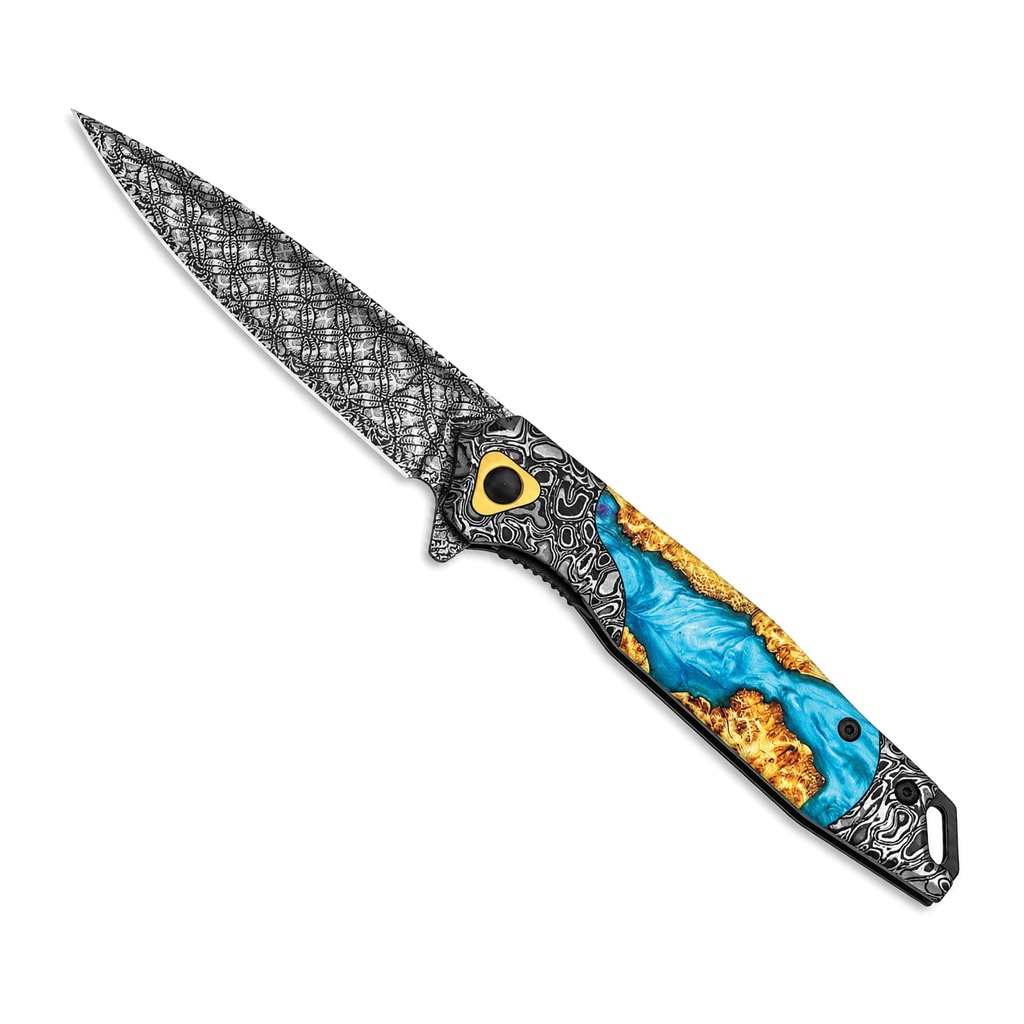
The Current Spring Assisted Knife is a folding knife you start opening by hand before spring assistance continues the movement. Its blade swings out from the side of the handle, rather than traveling through the front. Blue-and-gold marbling gives this particular folder its character, while black-and-silver patterning connects the blade to both ends of the handle. The mechanics are straightforward; the decoration gives you something to linger over.
That distinction matters when your collection includes an automatic knife, an OTF knife, or a traditional manual folder. Similar size does not mean similar operation. Here, you get spring-assisted deployment, a liner lock, and a 3.5-inch plain-edge drop point. Those are the working details beneath the color, and they deserve as much attention as the finish.
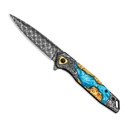
The turquoise-blue center flows between irregular gold-colored patches. Around it, darker contour patterns bring the design back toward the patterned blade. A gold-colored surround frames the black pivot center. Nothing about the color scheme is shy, but the repeated lines keep the separate parts looking connected.
How This Spring Assisted Knife Opens
A manual start, followed by spring assistance
A spring-assisted mechanism begins with your movement of the blade. Once that opening movement reaches the mechanism's engagement point, the spring helps continue deployment. The visible flipper tab provides an opening interface at the blade base. That manual start separates an assisted folder from an automatic knife, whose mechanism releases through a control such as a button or slide.
The distinction is mechanical, not a judgment about which category belongs in your pocket. If you enjoy handling different opening systems, this knife adds a specific kind of operation to the rotation. It should be chosen as an assisted opener rather than treated as a substitute name for every spring-powered knife.
A liner lock and a familiar folding layout
Once the blade is open, the liner lock engages to hold it in position. To close it, move the locking liner aside, keep your fingers clear of the blade's path, and guide the blade back into the handle. Familiarity with that sequence matters more than any decorative detail.
The handle curves inward behind the pivot and has visible grip ridges along its underside. Those contours give your hand defined reference points. A pocket clip and an elongated lanyard opening provide two attachment options, whether you prefer clipping the folded knife in a pocket or adding your own lanyard.
Assisted, Automatic, and OTF: Different Mechanisms, Clear Names
An automatic knife opens under spring power when its release control is activated. A switchblade is commonly another name for an automatic knife, not a separate blade shape. Side-opening automatics swing their blades outward from the handle. The Current also opens sideways, but its manual-start assistance places it in a different mechanism category.
An OTF knife sends its blade out through the front of the handle. OTF describes the blade's travel, while automatic describes how deployment is powered and released. The terms can overlap: an automatic OTF knife belongs to both categories. They are related terms, not interchangeable labels.
For your collection, the useful question is what the blade actually does when you operate it. This one rotates around a pivot after you initiate opening. Its spring assistance does not turn it into an OTF, and its patterned finish does not change the mechanism. Clear names make comparing knives considerably simpler.
Texas Carry and the Details Worth Collecting
At 4.75 inches closed and 8.25 inches overall, the Current gives you concrete dimensions to compare with a folder you already own. Measure against that familiar knife before deciding how it fits your pocket or storage tray. The 3.5-inch blade provides a useful reference beyond photographs, where proportions can be hard to judge.
The drop-point profile has a gently descending spine leading toward the tip. Its plain cutting edge has no serrated section, giving you one continuous edge for routine cutting tasks such as opening packaging. The bright edge bevel also creates a clean visual boundary against the dense black-and-silver blade pattern.
Blade material is 440C stainless steel. The Damascus-style look comes from the surface patterning; it is an ornamental treatment expressed through interlocking loops. For a collector, those are two separate points of interest: the specified steel and the appearance applied to it. Neither needs to borrow the other's credentials.
The stainless steel handle carries a printed finish, with black recessed screws near the rear. In a Texas collector's rotation, this is the colorful folder beside the more restrained pieces. Choose it because you enjoy coordinated ornament, a familiar folding layout, and a mechanism you can identify correctly—not because every knife needs to look alike.
What Texas Buyers Ask About a Spring Assisted Knife
Is this an OTF knife, an automatic knife, or a switchblade?
It is a spring-assisted, side-opening folder. You initiate blade movement, then spring assistance continues it. An automatic knife releases through a control, and switchblade commonly refers to that automatic category. An OTF knife deploys through the handle's front. This knife's blade pivots out from the side.
What laws should I check before carrying this knife in Texas?
Laws on spring-assisted knives, automatic knives, OTF knives, and switchblades vary by state and city. Check the law where you live and carry.
What makes this worth choosing over a plain assisted folder?
The coordinated decoration is the clearest difference. Flowing blue-and-gold marbling sits between patterned handle ends, while the blade repeats that intricate black-and-silver theme. Beneath it are specific, comparable features: 440C stainless steel, a plain-edge drop point, a liner lock, a pocket clip, and a lanyard opening. If you want color without giving up a familiar folding format, those details make a sound basis for your choice.
A Texas collection can make room for several mechanisms and several tastes. The Current earns its place as the patterned, blue-and-gold assisted folder: distinct in appearance, straightforward in operation, and easy to recognize when you reach for it. Knowing exactly what you own is part of the pleasure.