Duneline Ribbed-Grip Boot Knife - Tan Nylon Fiber
7 sold in last 24 hours
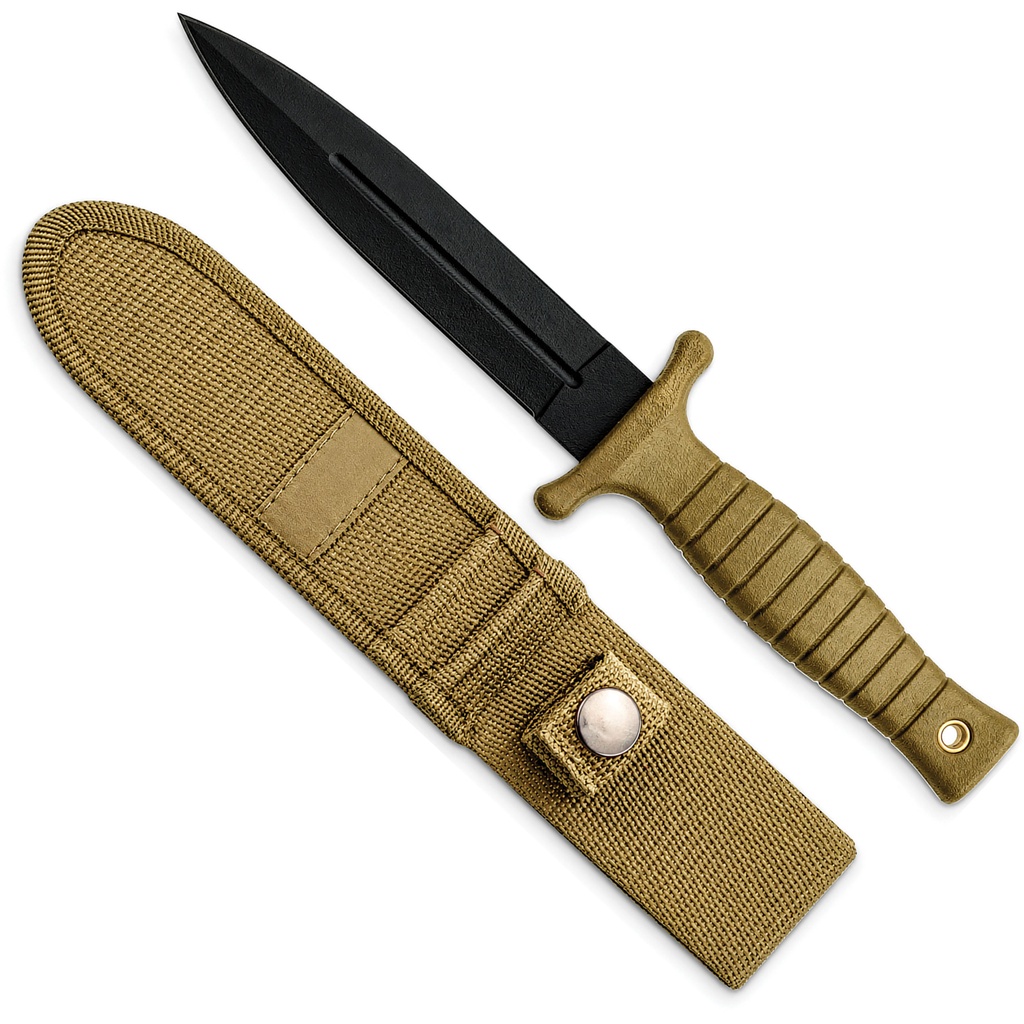
The Duneline Boot Knife is a fixed blade with a 4.875-inch dagger profile, a ribbed tan nylon fiber handle, and a matching nylon sheath. There is no opening action here: unlike an automatic knife or an OTF knife, the blade stays extended. Its matte black finish and curved guard give a Texas collector something distinct beside a switchblade collection. Before planning boot carry, check the law where you live and carry. The appeal is straightforward: coordinated materials, visible grip detail, and a knife you can identify without guessing.
| Blade Length (inches) | 4.875 |
| Overall Length (inches) | 9 |
| Blade Color | Black |
| Blade Finish | Matte |
| Blade Style | Dagger |
| Blade Edge | Plain |
| Handle Finish | Textured |
| Handle Material | Nylon Fiber |
| Theme | Tactical |
| Handle Length (inches) | 4.125 |
| Pommel/Butt Cap | Flared with lanyard hole |
| Carry Method | Boot |
| Sheath/Holster | Nylon |
The Duneline Boot Knife is a fixed blade, not a folder waiting on a button. Its 4.875-inch dagger-style blade stays extended, with a curved guard separating it from a tan nylon fiber handle. At 9 inches overall, it has a long, narrow visual line that carries through to the flared pommel. The matte black blade and matching tan nylon sheath make the design easy to recognize: restrained desert colors, close-set grip ribs, and no graphic competing with the shape.
A Boot Knife Built Around a Fixed Blade
The mechanism story is short because there is no opening mechanism. Remove the knife from its sheath and the blade is already in position. That distinguishes Duneline from an automatic knife, whose blade opens through a spring-powered mechanism, and from a folding knife that needs its blade rotated out of the handle. Here, the relationship between blade, guard, and grip stays the same in storage and in hand.
That simplicity gives you a different kind of object to study. Instead of a firing button or blade travel, your attention goes to the blade profile, the handle contours, and the sheath. In a collection built around different mechanical approaches, this boot knife represents the fixed-blade side plainly.
Dagger Profile and Recessed Fuller
The blade tapers symmetrically toward a centered point. A long recessed fuller runs along the visible blade face, adding a defined centerline to the matte black surface. The plain-edge styling keeps the outline free of serrations. These details give the blade its character without requiring decoration or a bright finish.
Boot Knife vs. Automatic Knife, OTF Knife, and Switchblade
These terms describe different things, and a useful collection starts by keeping them straight. A fixed blade stays extended. An automatic knife uses a spring-powered opening action activated by a control. An automatic can open from the side, or it can send its blade out through the front of the handle.
OTF means out the front. It describes the blade's travel rather than serving as a blanket name for every automatic. Many OTF knives are automatic, but the two terms are not interchangeable. Switchblade is a common term for an automatic knife; it does not describe this fixed-blade Duneline.
An assisted opener adds another distinction: you begin moving the blade manually before spring assistance takes over. None of those opening sequences applies here. If you collect mechanisms as much as silhouettes, Duneline gives you a clear contrast to the moving parts in an automatic or OTF design.
Tan Nylon Fiber, Ribbed Grip, and Curved Guard
The handle measures 4.125 inches and uses tan nylon fiber with a textured finish. Closely spaced transverse ribs run across the grip, while the spaces between them show a pebbled surface. Those two textures give the handle more visual depth than a smooth slab and make its construction worth a closer look.
The tan crossguard curves outward on both sides, making a distinct boundary between handle and blade. At the other end, the pommel flares around a round, metal-lined lanyard hole. The result is a handle with a defined beginning and end rather than an uninterrupted straight profile.
Small Details That Hold a Collection Together
The rib pattern, curved guard, and flared pommel repeat the same idea: shape does the work that graphics might do elsewhere. Beside polished metal handles or brightly finished folders, the black-and-tan combination brings a quieter look. You can build a display around the shared desert palette while keeping each knife's mechanism distinct.
Texas Carry Planning Starts With the Sheath
Duneline comes with a matching tan nylon sheath. Its woven surface contrasts with the ribbed handle, while fabric binding and visible stitching outline the perimeter. A retention strap near the opening closes with a silver-colored snap. A plain rectangular tan patch on the face keeps the presentation consistent with the rest of the design.
For a Texas buyer considering boot carry, overall length matters as much as blade length. This is a 9-inch knife before you account for the sheath around it. Think about your footwear, available space, and how the sheathed knife would sit during ordinary movement. The boot-knife designation describes its carry category; comfort remains a personal fit question.
Keep sheath retention and access in mind when comparing it with a pocket folder. An automatic stores its blade inside its handle, while this design depends on a separate sheath to cover the extended blade. That difference belongs in your carry decision before color or collection theme.
Where Duneline Fits in a Collector's Lineup
A boot knife earns attention through proportions and execution rather than an elaborate deployment sequence. Here, the 4.875-inch blade and 4.125-inch handle create a slightly blade-forward balance in the silhouette. The fuller draws your eye along the blade, and the tan guard brings it back to the grip.
If your drawer already holds side-opening automatics and front-opening designs, this fixed blade adds a different construction category without changing your preference for tactical styling. If you collect by color, the matching handle and sheath make a coordinated pair. Either approach gives the piece a clear reason to belong.
What Texas Buyers Ask About Boot Knife
Is this an OTF knife, an automatic knife, or a switchblade?
No. Duneline is a fixed-blade boot knife. Its blade does not fold into the handle or travel out through the front. An automatic uses a powered opening action, and switchblade commonly refers to that automatic category.
Can I carry this boot knife in Texas?
Laws on this type of product vary by state and city. Check the law where you live and carry before choosing your carry setup.
Why choose this one for a collection?
Choose it for the combination you can see: a matte black dagger profile, recessed fuller, closely ribbed tan handle, curved guard, and matching snap-retention sheath. Those details make a coherent design, not just a change of handle color.
For a Texas collector, knowing your knives means recognizing both the mechanism and the details around it. Duneline keeps that distinction straightforward: a fixed blade, a textured tan grip, and a sheath that belongs with it. It has its own place beside an automatic, not a borrowed identity.