Frontline Heritage Gurkha Kukri Knife - Brass & Leather
7 sold in last 24 hours
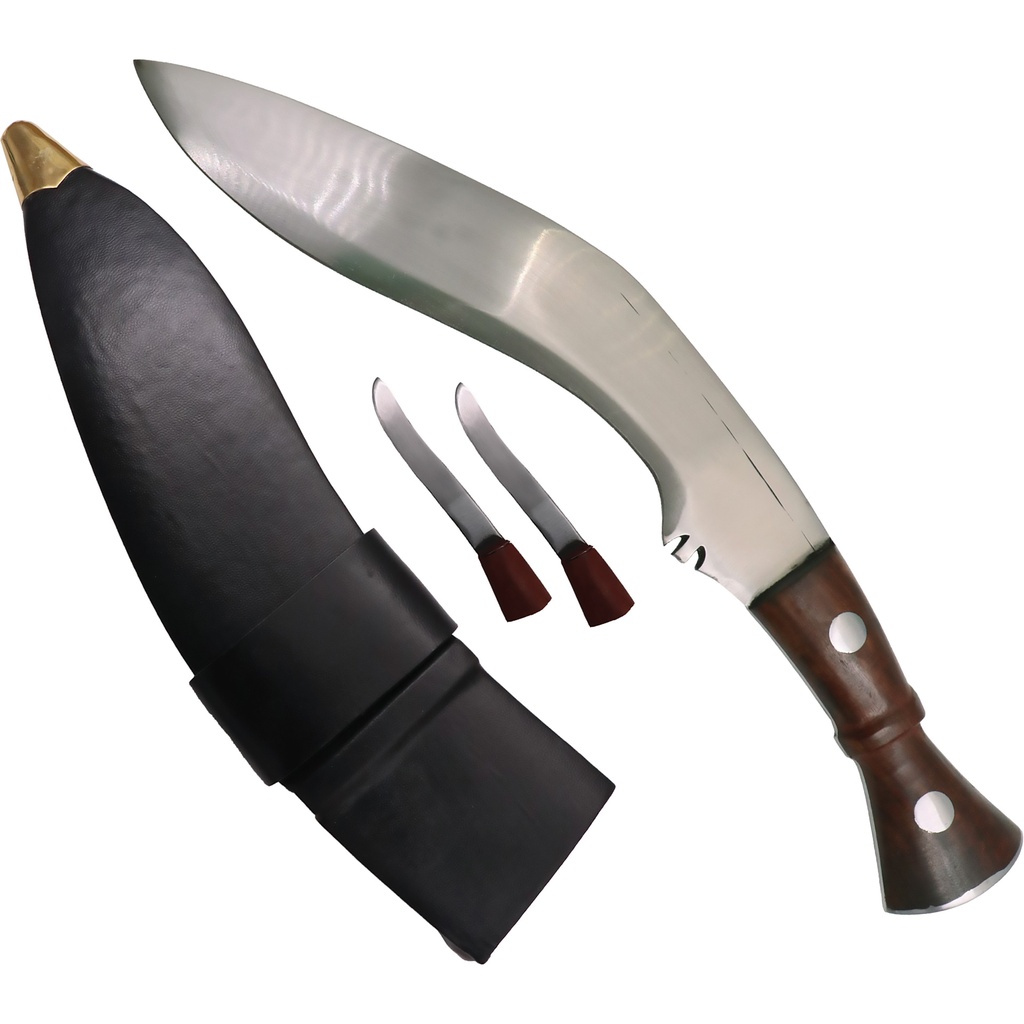
This Gurkha kukri knife is a full-size fixed blade built in the classic fighting-and-field pattern: 12 inches of forward-curved carbon steel, brass-fitted handle, and leather belt sheath. Karda and chakmak ride at its side for small cuts and edge touch-ups. In Texas hands, it’s a camp workhorse, a hog-processing brute, and a display piece with real history behind its shape. This isn’t an automatic or an OTF knife—it’s old-world reach and authority, ready for the wall or the pasture.
| Blade Length (inches) | 12 |
| Overall Length (inches) | 17 |
| Blade Color | Silver |
| Blade Finish | Polished |
| Blade Style | Kukri |
| Blade Edge | Plain |
| Blade Material | Carbon Steel |
| Handle Finish | Polished |
| Handle Material | Brass |
| Theme | Gurkha |
| Handle Length (inches) | 5 |
| Pommel/Butt Cap | Brass pommel |
| Carry Method | Belt sheath |
| Sheath/Holster | Leather |
What a Gurkha Kukri Knife Really Is
The Himalayan Edge Classic Gurkha Kukri Knife is a full-size fixed blade built on a fighting and field pattern that’s older than Texas itself. This isn’t an automatic knife, it isn’t an OTF knife, and it sure isn’t a switchblade. There’s no button, no spring, no sliding track—just 12 inches of forward-curved carbon steel, a brass-backed handle, and a shape that’s earned its place in military history.
Gurkha kukri knives like this one were designed to bite deep, chop hard, and carry their weight forward. In a Texas collection, it sits in a different lane entirely from your side-opening automatic knife or your double-action OTF knife. Those are fast, pocketable deployment tools. This is reach and leverage—part short machete, part survival knife, part battlefield legend.
Fixed-Blade Power vs. Automatic, OTF, and Switchblade Action
To a Texas buyer who knows their mechanisms, the distinction matters. An automatic knife snaps open from the side with a spring when you hit the button. An OTF knife sends the blade straight out the front of the handle on a track. A switchblade is the broader family those sit under in everyday conversation. This Gurkha kukri knife is none of those—and that’s exactly the point.
Being a fixed blade, it’s always ready. No deployment lag, no moving parts to foul with sand or mesquite dust, no springs to weaken. You draw it from the leather sheath and it’s at full power the moment it clears the belt. Where an automatic knife or OTF knife is built for quick one-handed opening in tight spaces, this kukri is built for open work: camp clearing, hog butchering, limb trimming, and heavy cutting that would make a typical switchblade fold under pressure—literally.
Mechanism: Simplicity That Outlasts Springs
The mechanism story here is straightforward: a full tang fixed blade with no pivot, no button, and no lock to fail. The deep curve of the kukri pushes weight forward, so the knife hits like a much larger blade while staying at a manageable 17-inch overall length. That’s why Gurkha knives built this way have stayed in service long after many automatic knife designs have come and gone.
Blade and Build: Carbon Steel, Brass, and Purpose
The 12-inch polished carbon steel blade carries a plain edge, ready for a proper sharpening stone instead of a quick pull-through. Carbon steel rewards a Texas owner who knows how to care for a working edge: dry it, oil it, and it will bite hard season after season. The handle runs a classic brass-backed profile with polished scales and a flared pommel that locks into your hand when the work gets heavy.
Riding beside the main blade are the traditional karda and chakmak. The karda handles fine tasks your big kukri is overbuilt for—small cuts, cord, and camp chores. The chakmak is your field touch-up piece, keeping that carbon steel honest without reaching for a full kit.
Gurkha Kukri Knife in Texas: Carry, Camp, and Culture
In Texas, a Gurkha kukri knife like this one mostly lives three places: hanging on the wall, riding in a truck, or strapped to a belt at deer camp or out on a lease. It’s not a pocket piece like an automatic knife or OTF knife, and it doesn’t try to be. This is your camp chopper, your brush clearer, your big-blade answer when a switchblade simply doesn’t have the reach or heft.
The leather belt sheath is built for that role. It keeps the forward-curved kukri contained against your side, brass tip down, with pockets for the karda and chakmak. Slide it through a belt, or tie it off to a pack, and you’ve got a full field kit in one rig.
Texas Law Context: Fixed Blade vs. Automatic Knife and Switchblade
Texas law is far friendlier to blades than it used to be. Switchblade and automatic knife restrictions have largely been lifted, and the state now focuses more on where you carry than how the blade opens. A fixed-blade Gurkha kukri knife falls under the same basic treatment as your other "location-restricted" large knives: be mindful of schools, certain government locations, and other posted areas. For the ranch, the lease, private land, and most adult carry situations, this big kukri sits right alongside your hunting knives without special automatic or OTF concerns.
As always, a smart Texas collector knows to double-check the latest statutes and any local ordinances—but in broad strokes, this kukri is simpler to understand than a switchblade when it comes to the law. It’s plainly a fixed blade working knife, not a concealed mechanical opener.
Collector Value: Gurkha Lineage in a Texas Collection
Every serious Texas knife drawer has its own balance: a few trusted automatics, maybe a slim OTF knife or two, a traditional lockback, and a couple of fixed blades that do the heavy lifting. A Gurkha kukri knife like this one doesn’t compete with your switchblades—it sits in a different chapter of the story.
Visually, the polished kukri curve, brass accents, and leather sheath with side knives draw the eye immediately. Historically, the Gurkha lineage and the forward-weighted profile give you a talking piece that most non-collectors have only seen in books. Functionally, it’s a camp and field tool that actually earns its keep, not just a wall hanger.
Collectors who appreciate mechanism variety can set this kukri beside an automatic knife and an OTF knife to show three completely different approaches to solving the same problem: getting a sharp edge into the work quickly. One does it with a spring from the side, one with a sliding track from the front, and this one by simply being ready every second it’s on your hip.
What Texas Buyers Ask About Gurkha Kukri Knives
Is a Gurkha kukri knife like this an automatic, an OTF, or a switchblade?
None of the above. This Gurkha kukri is a fixed-blade knife—no button, no spring, no sliding mechanism. An automatic knife opens from the side with a spring when you press a release. An OTF knife drives the blade straight out the front of the handle on a track. "Switchblade" is the everyday word people often use for both. This kukri skips all that. It rides in a leather sheath, draws clean, and is at full power the moment it clears the belt.
Is a big Gurkha kukri knife legal to carry in Texas?
Under current Texas law, large fixed blades like this Gurkha kukri knife are generally legal for adults, but they can be restricted in certain locations such as schools, some government buildings, and a short list of sensitive places. Unlike an automatic knife or OTF switchblade, you’re not dealing with a special "mechanical" category here—just size and location. For ranch use, hunting trips, camp carry, and most private-property work, this kukri is right at home. Still, any serious Texas owner keeps an eye on updated statutes.
Is this Gurkha kukri more of a display piece or a working field knife?
It does both. The polished 12-inch carbon steel blade, brass fittings, and traditional karda and chakmak make it worthy of a wall or stand in a Texas collection. But the forward-curved kukri profile was born for real work: chopping, clearing, breaking down game, and heavy camp chores where an automatic knife or compact switchblade simply can’t keep up. Treat it like a working fixed blade and it will pay you back in performance—and still look right at home on display when the day’s done.
For the Texas buyer who already owns more than one automatic knife and maybe an OTF or two, this Gurkha kukri knife adds a different kind of authority to the lineup. It’s not about deployment tricks or switchblade speed; it’s about history in the hand, forward-weighted power, and a brass-and-leather profile that says you know exactly why certain jobs call for a full-size fixed blade.