Hearthgrain Hand-Forged Cleaver Knife - Brown Pakka Wood
5 sold in last 24 hours
The Hearthgrain Cleaver Knife is a fixed-blade kitchen tool with an 8-inch hand-forged blade, 1080 high carbon steel, and a full tang. Its curved plain edge and broad face belong beside the cutting board, not in the same role as an automatic knife, OTF knife, or switchblade. Brown Pakka wood brings warmth to the rough-forged silver-gray blade. From a Texas home kitchen to a weekend cookout prep station, this is a piece for someone who appreciates the right knife for the work.
| Blade Length (inches) | 8 |
| Overall Length (inches) | 12.75 |
| Blade Color | Silver |
| Blade Finish | Rough-forged |
| Blade Style | Cleaver |
| Blade Edge | Plain |
| Blade Material | 1080 high carbon steel |
| Handle Finish | Polished |
| Handle Material | Pakka wood |
| Theme | Hand Forged |
| Handle Length (inches) | 5.25 |
| Tang Type | Full |
| Pommel/Butt Cap | None |
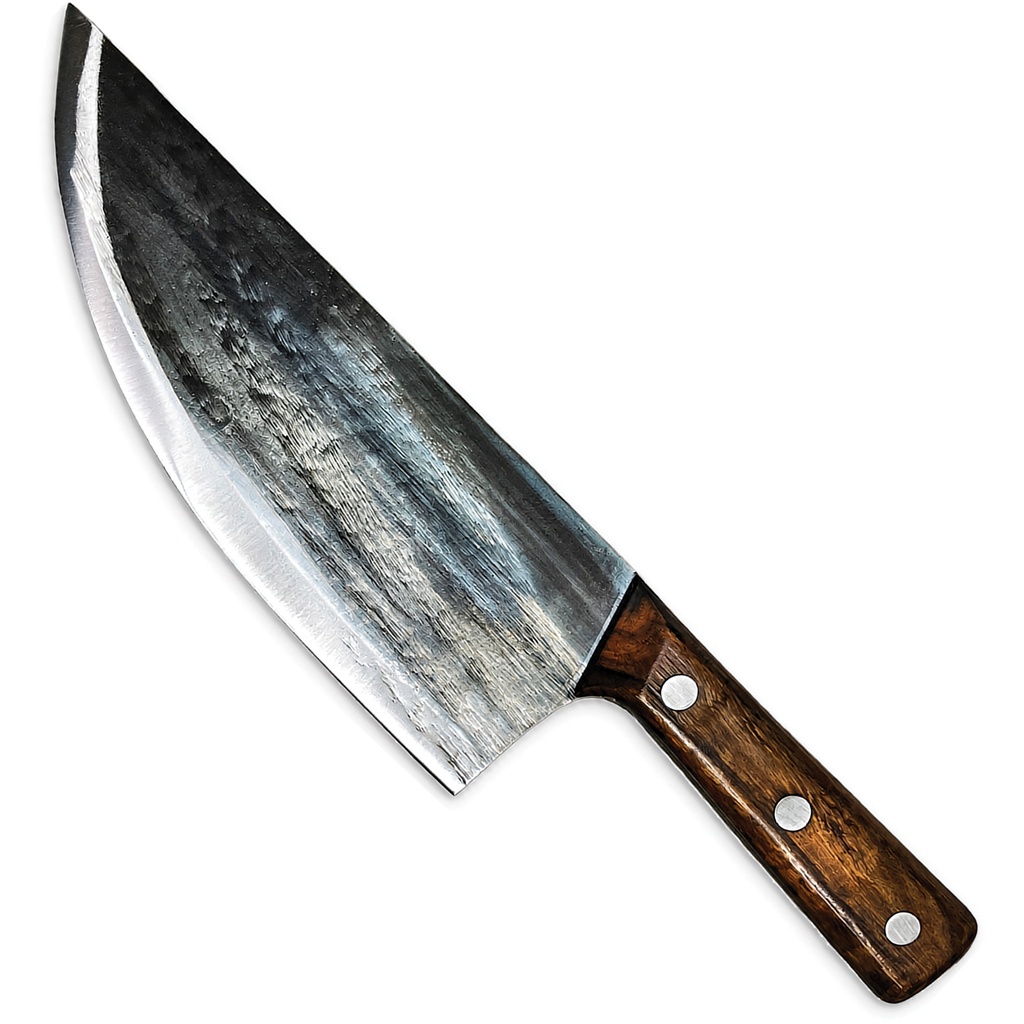
The Hearthgrain Cleaver Knife is a fixed-blade kitchen tool: an 8-inch hand-forged blade, a full tang, and a brown Pakka wood handle. Nothing folds, fires, or slides into position. Its broad, textured face gives way to a bright curved cutting bevel, making the working edge easy to distinguish from the darker forged surface. For a Texas cook who collects knives as carefully as recipes, that combination has a straightforward appeal. The construction is visible, the materials have character, and the purpose starts at the cutting board.
Hearthgrain Cleaver Knife: Fixed Steel, No Deployment
A fixed blade stays extended because the blade and handle form a permanent working assembly. There is no pivot to open, no release button, and no spring-assisted opening stroke. Here, the steel continues between the handle scales to the butt. That is the full tang: a construction detail you can see rather than a mechanism you have to operate.
The cleaver knife measures 12.75 inches overall, giving it the presence of a dedicated preparation tool rather than a pocket knife. Its blade heel drops below the handle, leaving visible clearance for your knuckles above the board. The lower edge curves toward a pointed front, while the spine follows a nearly straight line. Those details matter more to its kitchen identity than the rugged finish alone.
What Separates a Cleaver Knife From an Automatic?
An automatic knife opens through a mechanism activated by a button, slider, or similar release. A side-opening automatic swings its blade out from the handle. An automatic OTF knife sends its blade out through the front instead. Not every out-the-front design is automatic; the term OTF identifies the blade's path, while automatic describes how it opens.
Switchblade is commonly used for an automatically opening knife, including side-opening and automatic OTF designs. It is not a separate blade shape, and it does not describe this fixed kitchen tool. An assisted opener is different again: you begin moving the blade itself before a spring helps finish the opening stroke.
For collectors, these distinctions keep unlike tools in their proper company. A button-fired folder offers a deployment mechanism to examine. Hearthgrain offers a forged blade, an exposed tang, and traditional handle scales. Neither needs to borrow the other's identity to be interesting. This one earns attention through its construction and working profile.
Forged Texture, Carbon Steel, and Full Tang
1080 high carbon steel and a rough-forged face
The blade is 1080 high carbon steel, finished with irregular pits and elongated forging marks across its silver-gray face. A brighter bevel runs along the plain cutting edge. That contrast is the center of the design: textured steel above, a clean cutting line below. There are no serrations competing with the curve.
High carbon steel rewards ordinary, consistent care. Wash the blade by hand, dry it promptly, and use a light food-safe protective oil when appropriate for storage. Do not leave it soaking or put it away damp. A patina may develop through use; active rust still calls for attention. The rough-forged surface deserves drying just as much as the polished edge.
Pakka wood scales and visible full-tang construction
The brown Pakka wood scales show flowing golden and dark grain beneath a polished surface. Three round silver pins punctuate the handle, and the rounded edges lead into a gently flared butt. There is no separate pommel cap interrupting that outline. The result is visually warm without turning ornamental.
On this cleaver knife, the visible tang connects the blade's workshop appearance to the handle's simple construction. Full tang describes where the steel runs; it is not permission to pry, twist, or treat the knife as an axe. A collector can appreciate substantial construction while still choosing the right technique and cutting surface.
A Place in the Texas Prep Kitchen
Set Hearthgrain beside a board in a Texas kitchen and its role needs little explanation. Think vegetables before supper, herbs for a marinade, or ingredients laid out before a cookout. The broad blade and curved plain edge give you a different profile from a narrow utility knife. Let the food and task determine your cutting motion rather than assuming every cleaver is built for the same work.
A broad blade is not, by itself, a reason to strike bone or frozen food. Keep the work controlled, use a suitable cutting board, and protect the edge from hard surfaces. The pointed front and rising curve also distinguish this silhouette from the square-ended rectangle many buyers picture when they hear the word cleaver.
For transport between the house and a cooking setup, protect the edge and secure the knife so it cannot shift or be reached accidentally. This cleaver knife belongs in a deliberate kitchen-tool routine, not loose among other gear. Before carrying it beyond that setting, check the rules where you live and travel.
What Texas Buyers Ask About Cleaver Knife
Is this an OTF, an automatic, or a switchblade?
No. This cleaver knife has a permanently extended blade and no opening mechanism. An automatic knife uses a release-driven opening action; an automatic OTF knife opens through the front of its handle. Switchblade commonly refers to automatic-opening designs, not fixed kitchen cutlery.
Can I carry a cleaver knife in Texas?
Laws on this type of product vary by state and city. Check the law where you live and carry, including the places you plan to visit.
Why choose this for a working collection?
Choose it for the combination of hand-forged texture, 1080 high carbon steel, a curved plain edge, and polished brown Pakka wood. The broad face makes the finish prominent, while the full tang and three-pin handle give you construction details worth examining. It suits a collector who wants kitchen cutlery represented alongside other knife types, rather than another example of the same opening mechanism.
A worthwhile Texas collection can make room for both mechanical interest and honest kitchen work. Hearthgrain brings the latter: visible forging marks, warm grain, and a fixed blade with a clear purpose. Keep it cared for, give it a proper place beside the board, and let your knowledge show in choosing the right tool.